

Certain works in local museums just have to be seen
By Rick Romancito
Each museum in Taos exists to show a unique aspect of why our community is so special. One features the grand exploration of artists whose work shaped the community’s fame, while another brings a vivid multicultural history to light, and yet another looks at the role Taos has played in the evolution of the global art scene.
What follows is in answer to a question we posed to three Taos museums about which object in its collection might be considered a “don’t miss” to a first time visitor.
Blue magic at Millicent Rogers
There is a turquoise necklace in the collection at the Millicent Rogers Museum that will literally take your breath away.
As described by curator of collections Claire Motsinger, it is a stunning piece of historic Native American art made by famous Zuni Pueblo fetish carver Leekya Deyuse. This necklace consists of 294 pieces of Cerillos and Blue Gem mined turquoise that is considered “the most iconic of all the Southwestern jewelry pieces owned by Millicent Rogers.”
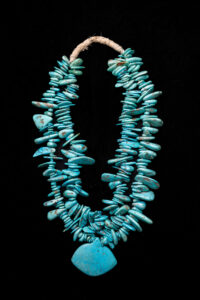
The museum’s namesake was born to a wealthy family associated with the founder of Standard Oil who became an American socialite, fashion icon, art collector and jewelry designer. In 1948, she moved to Taos where she began a collection of Native American art that her son, Paul Peralta Ramos, would use to establish a museum in her name after her death in 1953.
“Millicent’s friend John Joseph purchased the necklace shortly after Millicent saw it at the Gallup Intertribal Ceremonial in 1946,” Motsinger said. “Necklaces like this were made as works of art that honored the material and were not intended to be worn. The stones are all hard stone turquoise and probably represented several months of mining to obtain this many high-quality pieces.”
This necklace exists as “an abstraction of adornment,” Motsinger added. “It cannot be worn, yet it presents the form of a necklace. Instead, it speaks to the power of adornment, imparting qualities of protection, beauty, history, craft and connection to the land. Its vivid image has been used to promote the Millicent Rogers Museum and its extraordinary collection for many years as it represents not only the incredible value of the art but also its connection to land, history, tradition and artistic evolution in the American Southwest.”
It is certainly a piece of art not to be missed upon a visit to the Millicent Rogers Museum.
In addition, the museum maintains a singular collection of historic and contemporary works. Here you’ll see beautiful pottery from the renowned Maria Martinez family of San Ildefonso artists, religious art based in the Spanish Colonial tradition, stunning displays of Navajo and Hispanic weavings, and, on occasion, contemporary exhibitions opened to members of the regional public.
The museum is located at 1504 Millicent Rogers Road, four miles north of Taos off U.S. 64. For more information, call 575-758-2462.
Taos Art Museum at Fechin House
If you’re curious about the most precious work in the collection of the Taos Art Museum, it’s right there in front of you when you arrive. Standing in the parking area and walking into the courtyard is the evidence world famous artist Nicolai Fechin left behind.
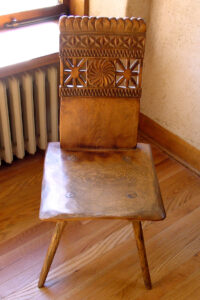
The historic Fechin House is itself the must-see work in Taos Art Museum’s collection, according to the museum’s Executive Director Christy Coleman.
“Nicolai Fechin’s craftsmanship is evident throughout the house, from the hand-carved doors, furniture and architectural details to the window designs and copper light fixtures. He brought together influences from his Russian heritage, the Pueblo and Hispanic cultures of Taos, and the architecture and materials of New Mexico, weaving those elements into a cohesive style that was entirely his own.”
His eye as a renowned painter is evident in the way he designed the house, “with careful attention to light, texture, proportion and space,” Coleman said. “Walking through the house is an immersive experience, with Fechin’s artistic vision unfolding from room to room. Even people who aren’t particularly interested in art are astounded by the Fechin House. And you don’t need to be familiar with Nicolai Fechin’s work to appreciate it as it stands on its own as an extraordinary work of art.”
Housed in the museum is the stunning collection of works by members of the Taos Society of Artists amassed by local artist and collector Duane Van Vechten. For a time, it was held in a museum built in Van Vechten’s honor by her husband Edwin Lineberry, and his later wife Novella, along with their collections. After that museum closed, the collection moved to the Fechin House, where it opened in 2002.
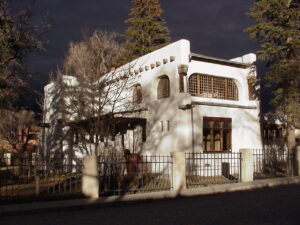
Fechin was a renowned Russian-American artist, who, with his wife, Alexandra, and their daughter, Eya, emigrated from Russia to New York City. In 1926, at the invitation of Taos patroness Mabel Dodge Luhan and the encouragement of artist John Young-Hunter, the Fechin family traveled to Taos and spent the summer at Mabel’s place.
Fechin eventually stated he needed his privacy to paint, and in 1927, he and his family acquired the property of Dr. J.J. Bergmans and his wife, Wilhelmina Harkink-Bergmans.
Fechin oversaw a major renovation employing many local craftsmen from Taos and Taos Pueblo. All interior, non-load-bearing walls were removed, and the spaces were reconfigured. They doubled the size of the front porch and added a series of rooms that projected from what was once the central cube, according to a history of the museum.
By 1933, Fechin had created one of the most exciting homes in Taos, a 3,545 square-foot, asymmetrical, adobe Pueblo and Mission Revival home that became known as a masterpiece of Southwest architecture.
In 1979, the Fechin House was placed on the National Registry of Historic Places and the State of New Mexico’s Register of Registered Cultural Properties. Living in the studio, Eya Fechin created the Fechin Institute and maintained active exhibition and education programs until her death in November 2002.
The Taos Art Museum at Fechin House is located at 227 Paseo del Pueblo Norte. For more information, call 575-758-2690 or visit taosartmuseum.org.
Contemporary reflection
The Harwood Museum of Art has been at the forefront of displaying artistic innovation germinating here since the earliest years of the Taos Moderns. Its choice of an object no one should miss is yet another reflection of this ideal.
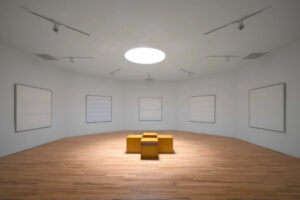
The Agnes Martin Gallery at the Harwood Museum of Art featuring seven works by the artist and four gold Donald Judd benches.
“Many visitors do not realize that Agnes Martin — one of the most important abstract artists of the 20th century — has a deep history with Taos,” said the Harwood’s Executive Director Juniper Leherissey.
Martin (1912-2004) was born on a farm in Canada and later moved to the United States to become a teacher. “She first came to this mountain town in 1947 to study at the University of New Mexico’s Field School of Art at the Harwood,” Leherissey said. As it turned out, this community was to be an anchor in her life as an artist.
Eventually, she left and established her career in New York. After spending years elsewhere in New Mexico, she returned to Taos in 1993, Leherissey said, “choosing it as the place where she would spend the final chapter of her life.” In so doing, the solitude and freedom she enjoyed helped her to become “an essential part of the story of Taos — and Taos is an essential part of the story of Agnes Martin.”
The Harwood’s choice for a must-see work in its collection is the gallery especially built to encompass seven paintings by Agnes Martin.
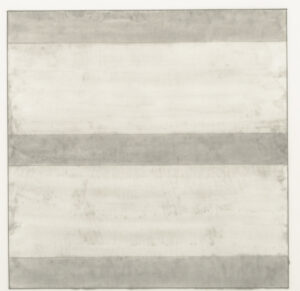
The permanent installation, Leherissey said, “brings that relationship into extraordinary focus. Envisioned through the close collaboration of Martin and the Harwood’s transformative director Robert M. Ellis, the intimate gallery was conceived as an immersive whole, with each work occupying its own wall beneath an oculus that shifts the quality of light throughout the day. Four gold Donald Judd benches invite visitors to sit and experience the works together, just as Martin intended.”
As one encounters these works in the Agnes Martin Gallery, one is immediately struck by the serenity and elusive sensations captured in their titles: “Lovely Life,” “Love,” “Friendship,” “Perfect Day,” “Ordinary Happiness,” “Innocence” and “Playing.”
The works do not demand that you understand them. Their subtle bands of blue and white, delicate graphite lines, and visible human touch reward time and attention. “The gallery,” Leherissey said, “is a place to enter Martin’s interior world — a space she helped create as a sanctuary of art and stillness for herself and for the world.”
The Harwood Museum of Art is located at 238 Ledoux Street, a short distance west of Taos County Plaza. Fore information, call 575-758-9826 or visit harwoodmuseum.org.