
Carved in Faith

The Santos of Millicent Rogers Museum

By Ellen Miller-Goins

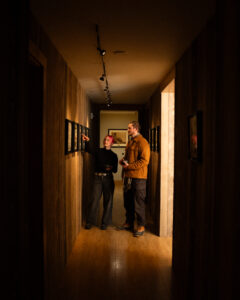
Inside Millicent Rogers Museum, carved saints gaze quietly from gallery walls and display cases. Some appear stern; others, tender. Their painted robes glow in deep reds, blues and golds, their surfaces worn with the patina that comes from time, touch and devotion. Together, these bultos and retablos form one of the most significant public collections of Northern New Mexico santos in the world.
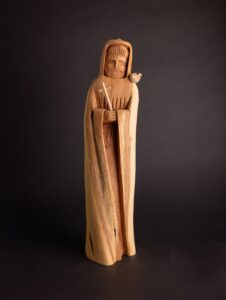
This is not a gallery to rush through. The best way to experience it is slowly, allowing your eyes to settle on the details: a saint’s face softened by age, the faint crackle of gesso, the brushwork along a sleeve, the way wood grain emerges through paint — a quiet reminder that these images begin as something living.

For those who grew up here, santos may feel as familiar as weathered adobe and cottonwoods lining an acequia. They appear in homes, chapels and churches, serving not only as works of art but as companions in prayer and daily life. In many families, they are passed down through generations, carrying both spiritual and personal histories.

At the Millicent Rogers Museum, that living connection remains central. “Part of what is so significant and rich about the santo tradition is the reference to the masters,” says Claire Pelaez Motsinger, museum curator. “These compositions and approaches are still being used in the contemporary tradition.”

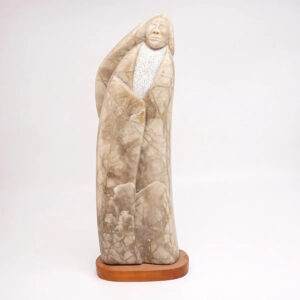
The forms themselves are simple to define, yet impossible to reduce. Bultos are carved wooden figures. Retablos are painted panels, often displayed on household altars or in churches and chapels. Both are created by santeros — artists who have shaped a distinctly Northern New Mexico tradition over centuries, tracing back to the colonial period.

Spanish missionaries introduced Catholic imagery as a way to teach religious stories. Over time, local artisans adapted these forms. Early santeros worked with what the land provided — cottonwood roots, ponderosa pine, natural pigments and piñon sap varnish. The results are not polished European icons, but something more immediate and human: sacred images shaped by local hands, knowledge, and devotion.
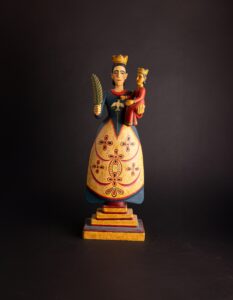
The Millicent Rogers Museum is one of only a handful of institutions with a collection of this scale. “We are one of eight museums that have more than 100 Northern New Mexico santos in their collection,” Pelaez Motsingers says. “It’s a very small group of institutions that represent this work on that scale.”

That breadth allows the museum to tell a more complete story. The exhibit is divided between historic and contemporary traditions, revealing both the roots and evolution of the form. Earlier pieces reflect Spanish colonial influence, while more recent works show how artists continue to reinterpret the tradition today.

Spend time in the gallery, and the distinctions begin to blur. Across centuries, the same gestures repeat: hands raised in blessing, eyes lifted upward, bodies carved with quiet intensity. What changes is not the purpose, but the artist’s voice.

“The museum demonstrates not just the objects, but a real sense of place,” Pelaez Motsinger says.

That sense of place is everywhere — in the materials, in the forms, even in the gallery itself. The rooms echo the textures and tones of Northern New Mexico, grounding the collection in the landscape that shaped it.
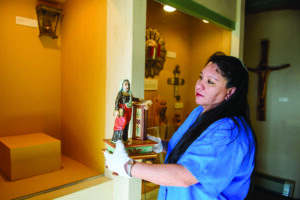
Santeros, past and present, are valued not only for their craftsmanship but for their devotion. Their work reflects a tradition that remains very much alive. Santos are not separate from everyday life. They are part of it. They have been handled, prayed to, repaired and passed down. They are artworks, certainly. But they are also reminders of a living tradition.

For many who pass through the gallery, the experience is not only visual. It is deeply human.

A Museum Rooted in Place

The Millicent Rogers Museum, founded in 1956 by Paul Peralta-Ramos (one of Rogers’ sons), includes 15 galleries arranged around a central courtyard in a hacienda-style layout.

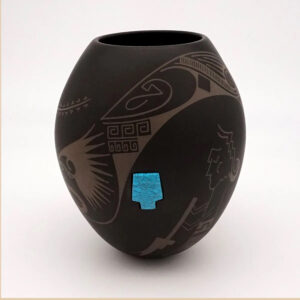
“It’s a home-like feeling combined with a formal museum setting,” says Claire Pelaez Motsinger. “We try to balance those two things.” One of the first stops for many visitors is the pottery gallery, anchored by the work of Maria Martinez of San Ildefonso Pueblo. The museum’s collection traces the arc of her career, from early polychrome and redware to the iconic black-on-black pottery she developed with her husband, Julian, and later continued with her family.

Nearby galleries expand that story of place and tradition. The museum holds more than 7,000 objects, including Native American art, jewelry, textiles and Hispanic devotional works, offering a broad view of the cultures that shape Northern New Mexico. The museum is moving toward a more focused exploration of the cultures it represents, while continuing to refresh galleries and rotate objects.

“We represent Hispanic and Native traditions in the area,” Pelaez Motsinger says. “That’s really where deeper education can happen.”

Following the death of executive director Karen Chertok, the museum is in the process of hiring new leadership, with a new executive director expected soon.

Millicent Rogers Museum

1504 Millicent Rogers Rd, El Prado

575-758-2462

millicentrogers.org

The Enduring Legacy of DeAnna Autumn Leaf Suazo

Millicent Rogers Museum to host a tribute to promising Taos Pueblo artist

By Rick Romancito

The art of an emerging Taos Pueblo artist whose life was tragically cut short is on display in a tribute exhibition — “Honoring the Life and Work of DeAnna Autumn Leaf Suazo” — at the Millicent Rogers Museum.

The artist of Diné and Taos Pueblo heritage created work that “reflected the cultural significance, aesthetics, and strength of her communities,” a museum statement reads. She was by all accounts a rising star in the art world.

Then, on Nov. 13, 2021, Suazo’s life was cut short at the hands of her boyfriend, Santiago Martinez, who later was sentenced to 10 years in federal prison after pleading guilty to voluntary manslaughter. The sentence drew widespread disappointment from DeAnna’s family and supporters who publicly stated it did not reflect the severity of the crime, a TV news report stated.

The daughter of well-known artists Gary David Suazo of Taos Pueblo and Geraldine Tso of the Navajo Nation, DeAnna, 29, began making art at an early age, according to an article by this writer in the June 2024 edition of Trend Magazine. One of her fondest memories is from the time she attended the Taos Pueblo Head Start program as a young child.

“We were drawing on the floor with crayons and I remember one of the teachers was like, ‘Oh wow, DeAnna, you put a neck on your person!’ And, for some reason, that memory always stuck. Why wouldn’t you put a neck on a human figure?,” she said. “My art now is about Indigenous women present today, so what I’m doing is incorporating traditional attire — of course, it’s pre-contact attire.”

“I’m Taos Pueblo and Navajo, but we’re also very modern and know how to balance the two,” she said.

DeAnna graduated from the Institute of American Indian Arts (IAIA) in the spring of 2021 with a degree in studio arts. She also was admitted to IAIA‘s inaugural “MFA in Studio Arts” cohort in Summer 2021.

“DeAnna loved celebrating her Diné and Taos Pueblo heritage and creating art that reflected Pueblo cultural significance and aesthetics,” reads a statement from IAIA issued upon her passing. “Inspired by heroic figures of Japanese manga novels, including Sailor Moon, she imbued her work with memory, resilience and good intentions. Her most recent work emphasized figural paintings of strong Indigenous women that, in her words, ‘grind every day for a better community.’”

Her father said a small posthumous show at the Indian Pueblo Cultural Center in Albuquerque drew huge crowds, many of whom left comments like, “I’m so glad someone finally is doing something with pop culture for Native Americans. I loved the girl with the bubble gum. I loved the sunglasses.”

DeAnna showed artwork at the Southwest Association for Indian Arts Market (SWAIA) for over a decade. She was also a featured artist at many national art markets including the Heard Museum Indian Market and Fair, the Autry Museum Artist Market and the Smithsonian National Museum of the American Indian Artist Market. She was a SITE Santa Fe Scholar and a 2021 Taos Fine Arts Visionary Artist.

“She will be remembered as a dedicated student, a devoted friend, a kind person, and a passionate artist whose creativity knew no bounds,” the statement concludes.

In downtown Taos, anyone driving along Civic Plaza Drive will be reminded of her as one of the images on a mural painted on the south wall of the University of New Mexico-Taos’ Rio Grande Hall. The “Historical Women of Taos” mural by renowned artist Jenny Ustick also features images of ancestral matriarch María Rosa Villalpando, historic preservationist Cleofas Martinez Jaramillo and philanthropist Helene Wurlitzer. The mural was unveiled in May of 2022.

Inspired by her sister Shaundine, DeAnna began making drawings at an early age that reflected her interests in the world around her, “making them to her style,” her mom, Geraldine Tso, said. “She just did what she wanted.” Starting with small drawings, she eventually wanted to do larger and larger pieces. “I just let her go with it,” Tso said.

As one would expect, losing her daughter in an act of violence affected her deeply. “It struck me really hard when I was first told by Shaundine who called me early that morning,” she said. “All I could think was a beautiful girl has been taken away. It hurt a lot.”

“To this day, I feel very sad that she’s gone. I always wait for her to come through the door and say, ‘Hi mom!’”

Honoring the Life and Work of DeAnna Autumn Leaf Suazo

Exhibition continues through March 1, 2027. Museum hours are 10 a.m. to 5 p.m., Thursday through Tuesday. General admission is $20, with $15 admission daily for veterans, students, and seniors (65+). Taos County residents receive free entry to the museum every Sunday. Free daily admission for children under 6, museum members, and tribal members.

Visit millicentrogers.org for updates about this exhibition and for winter hours.

Secret Galleries of Taos

Some of the town’s most remarkable art lives far beyond museums

By Haven Lindsey

In Taos, art is not always where you expect it. Yes, there are museums. Yes, there are galleries. But some of the most remarkable collections in town hide in places many visitors never think to look: hospital corridors, an active volunteer firehouse and even the restrooms at The Blake at Taos Ski Valley.

Inside Holy Cross Hospital, a quiet surprise stretches along the hallways: an art collection with well over 450 works. Paintings, photography, sculpture and mixed-media pieces line the corridors. Most pieces come from Taos artists, many of whom earn recognition far beyond Northern New Mexico.

The collection grows organically over decades as artists donate work — sometimes in gratitude, sometimes simply because art and community have always been intertwined in Taos. After all, the signpost banners declare: “Taos is Art.”

Today the result feels unexpected: a museum-scale collection embedded inside a place dedicated to healing. As visitors and patients walk the halls, they encounter landscapes, portraits and abstract works that reflect the artistic spirit of the region.

The art transforms an otherwise clinical space into something reflective, turning a simple walk down a hospital hallway into a quiet gallery experience.

If the local hospital’s art scene seems surprising, the next stop raises the element of surprise to a whole new level: the Taos Volunteer Fire Department, which may be the last place most people expect to find significant regional art.

Step inside the firehouse and the space tells a different story. Works connected to the artists who helped establish Taos as one of the most important art colonies in the American Southwest adorn the walls. Pieces by early Taos painters — including those who arrived in the late 19th and early 20th centuries and helped define the visual language of the region — form an extraordinary and largely unseen collection.

But why the firehouse? The story behind the art is as unusual as the location. In the 1930s, fires threatened buildings around Taos Plaza, underscoring the need for an organized fire department. When the community rallied to support the effort, artists contributed paintings as part of fundraising drives.

The works never sold. Instead, the department kept them, gradually building a remarkable collection displayed inside a building dedicated to protecting the town and its residents. Over time, the firehouse became an unlikely steward of Taos art history — and likely one of the safest places for it to appear; after all, it is rare that a firehouse burns.

From one unexpected sanctuary to another, the art trail continues uphill at The Blake at Taos Ski Valley. At the hotel named after Ernie Blake, the visionary founder of Taos Ski Valley, the art collection begins the moment guests walk through the doors and continues into places few visitors expect.

Historic photographs of the pioneering Blake family and early layouts of the ski valley greet guests in the lobby. Paintings by Oscar E. Berninghaus, Walter Ufer, Ernest Martin Hennings and Georgia O’Keeffe capture the breadth of Taos’ artistic heritage. Navajo textiles, woodblock prints by Gustave Baumann and historic photographs of Taos Pueblo appear in corridors, seating areas, the spa and yes, even the restrooms, turning the entire hotel into an immersive and unexpected gallery.

The Blake offers guided art tours by appointment at no charge, inviting visitors to explore these treasures and learn their history. From classic portraits to early skiing aerials, each space tells a story of Taos past and present, proving that in this town, the unexpected appears everywhere.

In Taos, art does not stay confined to museums and galleries. Look at the signposts or the stoplight utility boxes and you will see it everywhere —part of everyday life and quietly reminding us that creativity thrives in the most
unexpected places.

5 truly Taos books

By Ellen Miller-Goins

To understand Taos and Northern New Mexico, it helps to read it. At SOMOS, Taos’ literary hub, Executive Director Jan Smith and Bookshop Curator Danielle Freeman have assembled a reading list that offers a layered portrait of the region.

“Some are novels, some nonfiction, and some stories are accompanied buy photos,” Smith and Freeman said. “They each document life in Northern New Mexico in an earlier time — some more contemporary than others.”

Their selections explore “the cultural values and traditions of Northern New Mexico from different angles: fiction, historical, environmental, Pueblo life, Hispanic traditions, mystery, biography, agricultural and livestock issues.”

1. The Milagro Beanfield War

John Nichols

The first novel in Nichols’ New Mexico Trilogy tells the story of a small community’s fight to protect its water rights. When a local farmer diverts irrigaton to his beanfield, it sparks a broader resistance against development and outside control. Blending humor, activism and deep affection for rural life, the novel captures the enduring tension between tradition and change.

2. The Man Who Killed the Deer

Frank Waters

This classic novel follows a young Pueblo man whose actions set off consequences that are both legal and spiritual. Waters explores the conflict between Indigenous traditions and imposed Western systems, examining identity, responsibility and cultural balance. The story offers a thoughtful and enduring perspective on Pueblo life and values.

3. The Great Taos Bank Robbery

Tony Hillerman

In this collection of essays, Hillerman combines journalism, humor and keen observation to explore Northern New Mexico. From Crime stories to cultural insights, he captures the region’s distinctive personalities and contradictions. The results is an engaging portrait of place that is both entertaining and revealing.

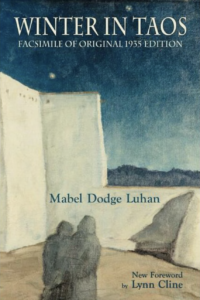
4. Winter in Taos

Mabel Dodge Luhan

Luhan’s memoir reflects on Taos during the early 20th century, when artists and writers were drawn to the area. She documents a period of cultural exchange, creativity and misunderstanding, offering a firsthand account of a pivotal moment in Taos history. The book remains both a historic record and a complex personal narrative.

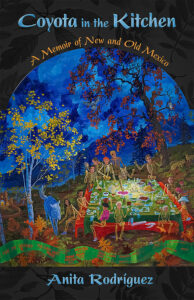
5. Coyota in the Kitchen: A Memoir of New and Old Mexico

Anita Rodríguez

Blending memoir, recipes and artwork, Rodríguez tells the story of family, culture and identity through food. Her writing reflects the rhythms of Northern New Mexico life, where traditions are preserved in kitchens shared across generations. The book celebrates memory, resilience and the everyday practices that sustain culture.

Turn it up this summer

Can’t-miss music experiences around Northern New Mexico

By Ellen Miller-GOins

From historic plazas to high-desert stages and mountain-town festivals, summer in Taos comes with a soundtrack. The 2026 season layers free concerts, destination festivals and world-class performances across Northern New Mexico — all within a day’s drive.

Summer in Taos doesn’t unfold on a single stage. It spreads outward — from the Taos County Plaza to the mesa, into the mountains and beyond — creating a season where live music becomes part of the landscape itself.

In 2026, that landscape is especially rich. A single weekend might take you from a free concert at sunset to a ticketed headliner under the stars, or from a cultural celebration on the Taos County Plaza to a multi-day festival in the high country.

Taos Plaza Live

Music at the heart of town

Nothing captures the spirit of a Taos summer evening like live music on the Taos County Plaza. Taos Plaza Live returns Thursdays from late July through August, filling the historic gazebo with rotating regional acts. The series is rooted in community — built through local band participation and shaped by the crowd that gathers each week. Families spread out blankets, visitors wander in from nearby galleries and restaurants, and the music carries through the adobe-lined streets as the sun drops behind the mountains.

taoschamber.com

Red Willow Park

Big sounds, open skies

Outdoor concerts continue to expand in Taos, and Red Willow Park is leading the charge. On Aug. 22, Thee Sacred Souls take the stage alongside The La Lom and The Womack Sisters, part of the Lensic 360 concert series. The setting strikes a balance between festival and hometown show — a broad lawn, open sky and a crowd that blends locals with visitors chasing a summer tour stop. More announcements are expected as the season unfolds.

lensic360.org

The Mothership

Music on the mesa

Out on the mesa, Taos Mesa Brewing’s “Music on the Mothership” series delivers a steady lineup of concerts all summer. Artists scheduled for 2026 include Los Lonely Boys, Shinyribs and Desert Dwellers. It’s as much about place as performance — wide- open views, sunset light and a pur- pose-built outdoor stage that turns every show into an experience. Start times vary, so checking ahead is part of the ritual.

taosmesabrewing.com

She Rises

A festival with purpose

The She Rises International Wom- en’s Music Festival returns July 16–18 at Daleee KTAOS, centering women in music through performances, workshops and community program- ming. More than a concert series, the festival creates space for connection and collaboration — a distinctly Taos approach to music that emphasizes both artistry and shared experience.

sherisesfest.com

Las Fiestas de Taos

Tradition in rhythm

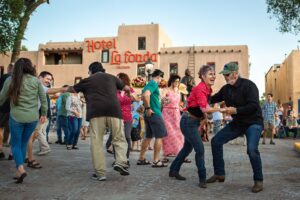
Las Fiestas de Taos (July 17–19) (pictured left) blends music with centuries-old cultural traditions on the historic Taos County Plaza. Mariachi, Spanish folk and community performances fill the weekend, accompanied by food, processions and gatherings that reflect the region’s deep roots. The full schedule typically comes later, but the atmosphere — vibrant, layered and distinctly Northern New Mexico — remains constant.

fiestadetaos.com

Red River Jamboree

A mountain music weekend

Just along the Enchanted Circle, Red River Jamboree (July 17–19) turns Brandenburg Park into a hub for country and Americana. The format is simple: bring your own seating, settle in for multiple days of music and let the mountain setting do the rest. A Sunday gospel session traditionally closes the weekend, giving the festival a communal, small-town feel.

redriverjamboree.com

Angel Fire

From blues to chamber music

Angel Fire’s summer calendar spans genres. BluewsFest (July 10–11) brings blues and craft beer together for a high-energy weekend, while the Summer Music Series adds weekly concerts beginning in June. Then, in August, Music from Angel Fire (Aug. 13–26) shifts the focus to chamber music, presenting performances by internationally recognized musicians in venues across the region.

visitangelfirenm.com

musicfromangelfire.org

8750’ Festival

Where music meets the grill

Aug. 12–16, Red River’s 8750’ BBQ & Music Festival combines live music with competitive cooking. Concerts unfold alongside BBQ, red chile and green chile cook-offs, creating a weekend that draws both music fans and food lovers. It’s a full-scale mountain-town event designed for lingering — not just a single night out.

8750festival.com

Big Barn Dance

Tradition under the stars

Michael Hearne’s Big Barn Dance returns Sept. 10–12, bringing its signature mix of Americana, country, folk and bluegrass to Taos for three days of music and community. Now in its 24th year, the festival has evolved from informal local gatherings into a well-known regional event, while maintaining its emphasis on songwriting and connection. Held at Red Willow Park, the format blends a “listening room” atmosphere with an outdoor festival setting, giving audiences a closer experience with performers and their work. The weekend traditionally builds toward a final night of dancing, reflecting the event’s roots as a community gathering centered on music and shared experience.

bigbarndance.com

Sunshine Festival

A labor day escape

Set in Sunshine Valley near Questa, the new Sunshine Festival (Sept. 4–5) offers a more immersive take on the music weekend. With camping, workshops and evolving programming, the festival blends music with art and community, inviting visitors to stay, explore and participate. It’s a fitting way to stretch the final days of summer.

sunshinefestivalnm.com

Blossoms & Bones

Music in O’Keeffe country

At Ghost Ranch in Abiquiú, Blossoms & Bones (Sept. 10–12) closes the season with a destination festival set among some of Northern New Mexico’s most iconic landscapes. The 2026 lineup features nationally recognized artists, while the experience extends beyond the stage — hiking, camping and exploring the terrain that inspired Georgia O’Keeffe.

ghostranchmusicfest.com

Bonus

A classical throughline

Beyond festivals, Taos’ summer music scene includes a strong classical presence. The Taos Opera Institute (May– June), Taos School of Music (June– August) and Taos Chamber Music Group all present concerts featuring emerging and established artists.

Walk through Taos

Shopping the heart of the Historic District

By Ellen Miller-Goins

In Taos, shopping isn’t something you rush through — it’s something you settle into. It unfolds slowly, one doorway at a time, blending art, culture and community into an experience that feels as layered as the landscape itself.

Just north of Red Willow Park, magpie shelves are filled with work by dozens of local artists — pottery, jewelry, folk art and functional pieces.

Nearby, Moxie Fair Trade & Handmade brings a global perspective, with colorful textiles, clothing and gifts. Then step into Aurora Folk Arts, where antiques, rare books, vintage finds and globally sourced goods fill every corner.

From here, head south toward the heart of town. As you approach the historic district, turn toward Bent Street, where the pace slows. At the corner, Pat Woodall Fine Art anchors the transition — a long-standing gallery showcasing contemporary realism and Southwest landscapes.

Then the path opens into Bent Street. Pop into Taos Cookery, a beloved kitchen shop housed in an old adobe, where locally made goods, cookware and whimsical finds sit alongside grab-and-go bites — perfect for a mid-shop snack.

Art lovers can linger at Robert L. Parsons Fine Art, where early Taos masters and historic works create a gallery experience that feels closer to a museum than a storefront. Made Solid offers handcrafted leather goods — each piece stitched and finished by hand — blending function, craftsmanship and timeless design. And at Jones Walker of Taos, the atmosphere is as memorable as the art itself. Explore clothing boutiques like Artemisia and Boxie Tees or floral design at Ultraviolet Floristry, each storefront adding its own personality to the walk.

John Dunn Shops

A courtyard experience

Tucked between Bent Street and the plaza, the John Dunn Shops offer a different kind of shopping — a shaded, pedestrian courtyard where the experience is as important as the stores themselves. Here, you’ll find everything from handcrafted jewelry and textiles to books, clothing and gifts. Inside the courtyard, shops like op.cit. Books offer a cozy, curated literary escape, while Seconds Eco Store highlights recycled and sustainably made goods with a creative twist.

At Las Comadres Gallery, a cooperative of local women artists, you’ll find everything from paintings to pottery — each piece carrying a distinctly Northern New Mexican voice. Shops like Mooncat Fiber, Bead Creations and Coyote Moon celebrate craftsmanship — whether through yarn, gemstones or vibrant folk art. Clarke & Co. Menswear stands out for its refined, contemporary men’s clothing, while Moda extends that same sensibility to women’s fashion.

Need a break? Grab a coffee or smoothie, sit by the fountain and watch the steady flow of people.

Taos Plaza

The heartbeat

Emerging from the courtyard, you arrive at Taos Plaza, the historic center where everything converges. Start at Chokolá Bean to Bar, tucked just off the plaza, where single-source chocolate, pastries and a decadent mousse bar offer the perfect reset.

From there, browse the plaza’s mix of longtime favorites and newer additions. Indigo Market offers a fresh, modern take on lifestyle retail, blending clothing, home goods and gifts with a distinctly curated feel. Nearby, shops like Made in New Mexico and Six Hand Hat Company celebrate regional craftsmanship, from locally made foods to custom, hand-shaped hats. Wander into shops like Touchstone Gallery and Two Graces, where minerals, books and art create unexpected moments of discovery.

The plaza is meant to be experienced more than once — each lap offering something new.

From the plaza, cross the street and step into Atcitty’s, where jewelry, art and gifts reflect the cultures and traditions of the Southwest. Then continue onto Kit Carson Road, where the atmosphere shifts — still central, but a little quieter, a little more contemplative.

Step inside Cabot Plaza to browse. Be sure to visit the famed Ed Sandoval Gallery, then head back down Kit Carson Road where a highlight is El Rincon Trading Post, one of Taos’ oldest shops. For generations, it has offered Native American jewelry, vintage pieces and handcrafted works. Wilder Nightingale brings a contemporary edge, with carefully selected clothing, accessories and design-forward pieces that feel both current and rooted in place. Parsons Gallery of the West offers a look at historic and contemporary Western art, while Alhambra – Soul Inspired Living invites visitors into a thoughtfully curated space of furniture, textiles and globally inspired pieces.

The walk naturally loops back toward Paseo del Pueblo, connecting the district into one experience. In the end, shopping in Taos isn’t about checking items off a list. It’s about wandering and stepping into spaces where artists, makers and shop owners are often the same people. About discovering some- thing unexpected.

Because here, every purchase carries a story. And every story is part of Taos.

Ranchos de Taos

Where history lives, breathes — and welcomes you in

By Ellen Miller-goins

There are place in Northern New Mexico where history is preserved. And then there is Ranchos de Taos — where history is still alive.

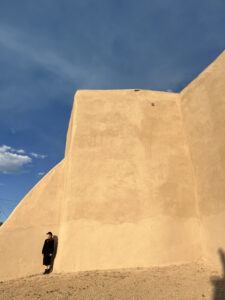
Begin, as generations have, at the heart of it all: the San Francisco de Asís Mission Church. Rising from the earth in soft, sculpted curves of adobe, the church feels less constructed than grown — an organic form shaped by human hands and time itself. Built between 1772 and 1816, it remains one of the finest examples of Spanish Colonial architecture in the United States.

Stand quietly behind the church in the late afternoon light and you begin to understand why artists like Georgia O’Keeffe and Ansel Adams returned to it again and again. The famous rear view, with its rounded, beehive buttresses, captures something elemental: light, shadow, earth and spirit in perfect balance.

The church is not a relic. It is still the center of daily life here. Parishioners gather for Mass, volunteers re-mud the adobe each summer, and visitors are welcomed into a space that has never stopped being what it was built to be.

Just steps from the church, the story of Ranchos unfolds. Step inside Chimayo Trading del Norte, a place often described as a museum where everything is for sale.

Housed in nearly 300-year-old adobe buildings on the north side of the plaza, Chimayo Trading is more than a gallery. It is a living continuation of Northern New Mexico’s artistic traditions, representing Native, Hispanic and Anglo art forms, from historic masters of the Taos Society of Artists to today’s leading contemporary voices.

Owner Gabriel Abrums describes Ranchos as something increasingly rare: “the last real holdout of old New Mexico …. a real plaza where people live, work and go to church.”

That authenticity is palpable the moment you walk through the doors. Hand-hewn vigas stretch overhead. Floorboards, patched with tin, creak softly underfoot. Light filters across pottery, weavings, jewelry and paintings — some contemporary, others centuries old.

For Abrums, the setting is inseparable from the art itself. “The character of the buildings …lends itself to displaying the art the way it’s supposed to be seen,” he says. Here, the connection between past and present is not curated — it’s continuous.

Across from the church, the scent of red chile draws you into another Ranchos institution: Ranchos Plaza Grill. For decades, the Medina family has served what many locals consider the gold standard of Northern New Mexican cuisine: simple, honest food rooted in generations of tradition. Dishes are prepared the way they always have been, allowing the ingredients — especially the chile — to speak for themselves.

“It offers the best traditional New Mexican food in Northern New Mexico,” Abrums says. “And I tell that to everybody that walks in the door.” The setting is as memorable as the food. Thick adobe walls, low doorways, and rooms filled with folk art create a sense of warmth and continuity.

From there, Ranchos invites you to wander.

Across the road, RB Ravens Gallery offers a deep dive into Native American and Southwest art. Nearby, Ranchos Antique Furnishings feels like stepping into another era entirely. Just down the highway, Vargas Tile Company show- cases vibrant handcrafted tile, while a few miles farther, Taos Drums carries forward a centuries-old tradition of drum making.

Make a day of it.

Start your morning at Ranchos Plaza Grill, where traditional Northern New Mexican breakfast — think huevos rancheros or a smothered breakfast burrito — sets the tone for a day rooted in flavor and family tradition. For lunch, stop at Trading Post Market for a relaxed meal before continuing your exploration of the plaza.

At day’s end, head to Old Martinez Hall. A beloved community gathering place for generations, this historic adobe landmark is reopening for summer 2026 as a lively community gathering space. Now operated by Heritage Hotels & Resorts and led by executive chef Cristina Martinez, the hall will feature a casual New Mexican menu, a full bar and regular live music, including Sunday afternoon performances (2–5 p.m.). Designed to be family-friendly, the venue will also host weddings, private events and celebrations, continuing its long tradition as a place where generations of Taoseños have gathered for music, food and community.

Bed down at Desert Flower Boutique Hotel, LUXX Lodge Glamping & RV Park (both featured elsewhere in this publication), Adobe & Pines Inn/ Hotel Bed and Breakfast or the new vacation rental at Chimayo Trading del Norte.
Ranchos de Taos is not polished. It is not manufactured. It is art that blooms from tradition, food that comes from family, and a church that still anchors it all.

Sleep Outside the Lines

Northern New Mexico’s most unique Airbnb, VRBO and other rentals

By Ellen Miller-Goins

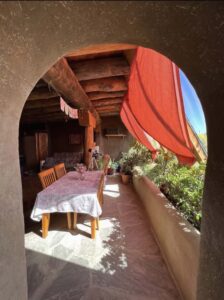
In Northern New Mexico, where landscape and creativity go hand in hand, where you stay can be just as memorable as what you do. Across Taos County and the surrounding region, a growing collection of short-term rentals offers something beyond the expected. From handcrafted treehouses and off-grid Earthships to high-desert yurts and retro trailers, these stays are not just places to sleep — they’re places that tell a story.

Among the trees

Elevated escapes in Northern New Mexico

Treehouses in Northern New Mexico lean less toward childhood fantasy and more toward quiet immersion — spaces designed to slow you down and pull you into the landscape.

In Angel Fire, RidgeWalk Treehouse offers a true canopy-level experience. Perched above a forested valley, the cabin opens onto a wide deck where mornings begin with coffee and hummingbirds and evenings stretch into long sunsets. Guests often mention the thoughtful hospitality and attentive hosts, which transforms the stay from simple lodging into something more personal. Wildlife sightings are common, from deer and elk to smaller forest creatures, reinforcing the sense of being tucked into the mountains. Book directly at ridgewalktreehouse.com.

Closer to Taos, a second Treehouse on the Rio Hondo in the Valdez Valley 6 miles north of Taos offers a different kind of charm. Built by a local artist on a rural property north of town, the structure feels handcrafted and intimate, with a small deck overlooking open land dotted with wildlife. Alpacas graze nearby, and sculptural details throughout the property reflect the creative spirit of the area. Available through VRBO and Airbnb listings in Valdez/Rio Hondo Valley (search “The tree house on the Rio Hondo Valley Alpacas” to book).

Built from the earth

The enduring appeal of Taos Earthships

Few places in the world offer the concentration —and variety —of Earthships found in Taos County. These off-grid homes, pioneered by architect Michael Reynolds, are designed to work with the environment rather than against it. The two-bedroom “Virtual Hideaway” offers a classic introduction. Built with natural and recycled materials, the home uses passive solar design to regulate temperature, while thick adobe walls and three kiva fireplaces create a warm, grounding interior. Set on a secluded mesa just 15 minutes from town, it feels both remote and accessible — a balance that draws first-time Earthship visitors and returning guests alike. Book through airbnb.com (search “Taos Earthship – Virtual Hideaway”).

Beyond this, Earthships across the region range from compact studios to greenhouse-filled homes that harvest rainwater and generate their own energy. Many are available through Airbnb’s “earthship rentals” category in Taos County.

Canvas and sky

Yurts and open-air living

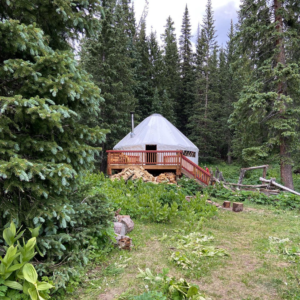
For travelers seeking simplicity without sacrificing comfort, yurts offer a middle ground between camping and traditional lodging. At Enchanted Forest Cross Country Ski Area, yurts serve as high-country basecamps set within alpine terrain. Book directly at enchantedforestxc.com/yurt-rentals.

Nearby, Southwest Nordic Center offers a similar backcountry-style experience near Taos Ski Valley and the New Mexico-Colorado border, with yurts positioned along its trail system. Reservations are available at southwestnordiccenter.com/reservations.

Further south near Abiquiú, a hillside yurt overlooking the Chama River offers a contrasting desert experience. Here, mornings unfold slowly on the deck, afternoons are spent exploring nearby trails and evenings bring expansive views of the night sky. Book via airbnb.com. (search “Abiquiú yurt overlooking the Chama River”).

Playful and unexpected

Trailers, containers and creative builds

Northern New Mexico has long attracted unconventional thinkers — and that spirit carries into its lodging. These smaller-scale stays often serve as basecamps, but they also embody the region’s creative ethos: reuse, reinvention and a willingness to do things differently.

On the mesa west of Taos, Hotel Luna Mystica reimagines the classic roadside stay with a collection of restored vintage trailers — each with its own personality, from mid-century Spartans to Airstreams from the 1960s. Set against wide-open desert and big skies, the experience blends nostalgia with comfort, including modern amenities like air conditioning and easy access to the adjacent Taos Mesa Brewing. Book directly at hotellunamystica.com.

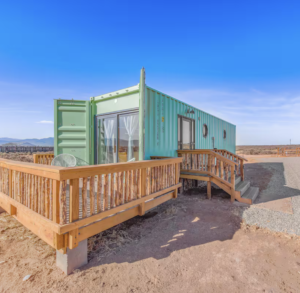
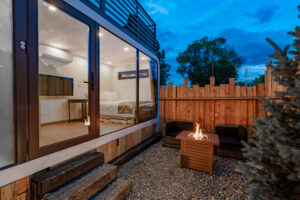
Nearby, shipping container homes — sometimes called “Steel Pueblo” builds — reflect a growing interest in sustainable, modular design, often featuring modern interiors, hot tubs and unobstructed mountain vistas. Look on Airbnb and VRBO in the Taos/El Prado area (search “Shipping container in El Prado, New Mexico).

Imagination and landscape

Adifferent way to stay

In a region defined by artists, builders and independent thinkers, ti makes sense that lodging would follow suit.

Whether it’s a treehouse tucked into the forest, an Earthship embedded in the desert or a yurt perched high in the mountains, these stays offer something beyond accommodation. They offer perspective —a way ot experience Northern New Mexico not just as a destination, but as a place shaped by imagination, landscape and possibility.


Amazing Places to Bed Down

LUXX LODGE

Glamping meets classic road trip camping.

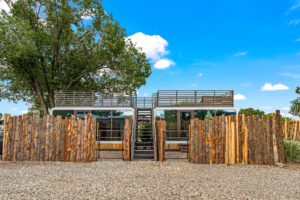
A new kind of campground has arrived in Ranchos de Taos. LUXX LODGE blends the nostalgia of the American road trip with modern glamping comforts, offering everything from RV hookups and tent camping sites to boutique lodge suites and futuristic tiny homes known as ‘space cabins.’ The property includes 19 full-hookup RV or van sites, multiple tent or car camping sites, lodging suites, an Airstream, plus public restrooms with indoor saunas, laundry facilities and dog-friendly outdoor spaces. The space cabins feature all-glass fronts, rooftop decks and private patios that showcase sweeping views of the Taos mountains.

Operations manager Lux Mullen describes the cabins as striking and futuristic accommodations. “They’re like Space Age modular units with an all-glass front. They’ve got rooftop decks so you can see the beautiful Taos mountains and private patios on each one,” Mullen says.

Mullen says the team continues to refine the property as renovations progress, including new glamping units, a Swim Spa hot tub and additional guest suites.

Luxx Lodge sits within walkingdistance of Ranchos Plaza Grill, the Trading Post Market, Mountain Monk Coffee and the historic San Francisco de Asís Church.

LUXX LODGE
1802 Paseo del Pueblo Sur, Ranchos de Taos

575-201-3339

luxxlodge.com

Desert Flower

A boutique hotel rooted in art, food and community.

In Ranchos de Taos, Desert Flower offers a deeply personal take on the boutique hotel experience. Owners Jody and Xochitl Wodrich transformed the former Casa de Taos Motel into a seven-room retreat that celebrates art, design and the spirit of Northern New Mexico.

Each room features its own theme and carefully curated aesthetic, with artwork from regional artists and custom playlists designed to match the mood of each space. Some rooms feature large copper soaking tubs, while the courtyard invites guests to linger with wine and charcuterie.

The couple also planted fruit trees and gardens on the property and raise chickens so guests can enjoy farm- fresh breakfasts and salsas.

“It was a very natural progression for us, just based on our own wants and desires when we travel,” Jody Wodrich says. “I’ve seen so many hotels, the five-stars to the smaller hotels, and there are things that you would stop and notice. We wanted to make sure those types of things were in our hotel.”

The hotel highlights local culture with Taos-roasted coffee, locally sourced bath products and artwork throughout the property. The owners also envision pop-ups, storytelling events and live music that immerse visitors in the culture of Taos.

“We really wanted to create a place that gives people an experience,” Wodrich says.

Desert Flower Boutique Hotel

4035 NM 68, Ranchos de Taos

818-398-7799

desertflowerhotel.com

4K River Ranch

A mountain base camp along the Red River.

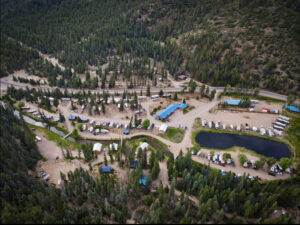
For travelers who crave cool mountain air and a classic Northern New Mexico summer escape, 4K River Ranch in Red River offers cabins, condos and RV sites on a 17-acre property where the Red River flows through the landscape.

The property has deep roots in the valley. The land once belonged to early Red River resident Orin Mallette, a blacksmith and miner who operated a brick kiln there in the late 1800s.

In 1936 the property became Lewis Ranch, a tourist resort with rusticcabins built from sawmill log slabs. Those early cabins helped establish Red River as a mountain getaway long before the modern ski town emerged.

The family-run property has welcomed guests since the 1970s and continues to evolve with new riverfront cabins featuring fireplaces, kitchens and year-round availability.

“We built brand new cabins on the river,” co-owner Paulette Kiker says. “They’re beautiful two-bedroom cabins right on the river with fireplaces, and we rent them year round.”

Guests can fish in the property’s stocked trout pond or in the Red Riveritself, relax beside the water or enjoy live music on summer evenings.

“We stock the pond once a week starting in May through September,” Kiker says.

Located just a mile from downtown Red River, the ranch provides easy access to hiking, fishing and scenic drives around the Enchanted Circle.

4K River Ranch

1501 W Main St, Red River

575-754-2293

4kriverranch.com

Sunsets, Views and Patios

Top 10 patios worth lingering on

By Ellen Miller-Goins

There’s a certain moment in a Northern New Mexico summer evening — when the heat softens, the light turns honey gold and the mountains begin to glow — that feels like an invitation. Pull up a chair. Order another drink. Stay a little longer. In Taos and around the Enchanted Circle, outdoor dining isn’t just a seasonal perk. It’s part of the culture. From tucked-away adobe courtyards to wide-open alpine decks, these patios offer some of the most memorable meals in the region.

The Stakeout

Outlaw Hill South of Taos

High above the valley on Outlaw Hill, The Stakeout delivers one of the most cinematic dining experiences in Northern New Mexico. Once a rumored hideout for outlaws and later a counterculture haunt, the revived property now blends history, design and sweeping views into something entirely its own.

The outdoor terraces open to panoramic vistas of Taos Mountain, Mesa Pedernal and the Rio Grande Gorge, with sunsets that feel almost theatrical. As the sky deepens, the space shifts into something more intimate — chimeneas glow, cocktails flow and live music often drifts across the property.

The menu draws from local ingredients with global influence, featuring thoughtfully plated dishes that highlight regional flavors — seasonal vegetables, expertly prepared meats and inventive small plates. Much of the cooking centers around a wood-fired grill, adding depth and a subtle smokiness that carries through the menu, alongside a strong cocktail program that makes the most of local spirits. Come for dinner, but plan to linger.

101 Stakeout Dr, Ranchos de Taos

575-425-0065

stakeouttaos.com

The Terrace at Taos Country Club

Ranchos de Taos

For wide-open views and a sense of space, The Terrace delivers. Perched above the rolling greens of the Taos Country Club, the patio offers sweeping vistas that stretch from Santa Fe to Colorado.

The menu leans into New Mexican flavors alongside classic comfort fare, making it an easy choice whether you’re finishing a round of golf or simply chasing a sunset dinner. Expect burgers, hearty sandwiches, fresh salads and regional favorites, paired with margaritas, beer and cocktails.

With the quiet rhythm of the course in the background and mountains on the horizon, it’s one of the most relaxing places to dine outdoors in the valley.

54 Golf Course Drive, Ranchos de Taos

575-758-7300

taoscountryclub.com

Lambert’s

Taos

Few patios feel as quietly magical as Lambert’s. Tucked along Bent Street, the courtyard centers around a towering apple tree — a living remnant of the building’s past — whose branches cast dappled shade by day and frame twinkling lights by night.

Opened in 1989 and now stewarded by the Troy family, Lambert’s has long been a cornerstone of Taos dining. In the kitchen, chef Adam Dooling brings a refined, ingredient-driven approach, drawing from local farms and ranches to shape a menu that feels both rooted and elevated.

Menu standouts include lobster risotto, filet mignon and seasonal vegetable plates, alongside house-made pastas, breads and desserts. Cocktails like the Sandia Spritz and a thoughtful wine list round out the experience, making it a place where dinner easily turns into a long, lingering evening under the trees.

123 Bent St., Taos

575-758-7200

lambertsoftaos.com

The Taos Inn (Adobe Bar and Doc Martin’s Patio)

Taos

Hidden just off Paseo del Pueblo Norte, the Taos Inn’s back patio feels like a secret garden in the center of town. Adobe walls, blooming flowers and a towering cottonwood create a shaded oasis that contrasts beautifully with the bustle of the plaza.

The experience is layered — music from nearby Red Willow Park drifts in, cocktails arrive cold and colorful, and the menu offers everything from elevated New Mexican fare to classic comfort dishes. Favorites include Doc’s Nachos, blue corn piñon-crusted trout and braised bison ribs, along with their well-known margaritas.

Whether you’re on a date or gathering with friends, it’s one of Taos’ most beloved and enduring outdoor dining spaces.

125 Paseo del Pueblo Norte, Taos

855-961-1143

taosinn.com

Martyrs Steakhouse

Taos

Set in a historic adobe home just off the plaza, Martyrs offers a patio that feels both elegant and deeply rooted in Taos history.

Shaded by mature trees and surrounded by adobe walls, the space invites you to slow down — order a cocktail, share a few small plates or settle in for a full dinner. Menu highlights include steaks grilled to order, lamb tacos, calamari and fresh seasonal sides, along with cocktails like lavender lemonade and rotating specials.

There’s a timeless quality here, where the past and present blend seamlessly, making it a favorite for both locals and visitors looking for a refined outdoor experience.

146 Paseo del Pueblo Norte, Taos

575-751-3020

martyrssteakhouse.com

Daleee at KTAOS Solar Center

Taos Ski Valley Road

Set against sweeping views of Taos Mountain, this expansive patio is one of the most dynamic outdoor gathering spaces in Northern New Mexico.

The scene is equal parts laid- back and high-energy — volleyball games in the sand, live music on the outdoor stage and a steady flow of locals and visitors soaking in the alpine atmosphere. A tiki bar anchors the space, while green grass, tables and open sky create room to spread out and stay awhile.

The menu is consistent and crowd-pleasing, with daily happy hour specials and a full calendar of events that keeps the vibe going seven days a week. Grab a margarita, find a spot under the string lights and watch the sun dip behind the peaks. It’s casual, vibrant and unmistakably Taos.

9 NM-150

575-425-0010

daleeektaos.com

Pizaños

Taos Ski Valley Road

There’s something wonderfully simple about sitting outside with a great pizza and a view — and Pizaños does both so well.

The patio faces Taos Mountain, offering a peaceful, open setting. Families love the grassy space for kids, while regulars swear by the wine margaritas and consistently excellent pastas and pizzas.

Owner Charley Galer — who fell in love with New York-style pizza and brought that influence west — opened Pizaños in 2005 and still plays an active role in the business.

Come at sunset or, better yet, during a full moon rise — when the mountain glows and the sky takes on that unmistakable Northern New Mexico magic.

23 NM-150

575-776-1050

taospizza.com

Blonde Bear Tavern

Taos Ski Valley

This alpine-inspired patio at Edelweiss Lodge offers a quieter, more refined take on outdoor dining in Taos Ski Valley.

Surrounded by aspens, the setting feels relaxed — a welcome contrast after a day on the trails. In summer, the Blonde Bear shifts gears, offering a brunch-style menu Fridays through Mondays with breakfast and lunch picks that fit the slower pace of summer days.

The menu leans toward fresh, approachable fare — think breakfast classics, light and refreshing summer dishes, sandwiches and salads — alongside espresso drinks, cocktails and a full bar.

Blonde Bear Tavern delivers a relaxed, high-altitude dining experience.

106 Sutton Place, Taos Ski Valley

575-737-6900

blondebeartavern.com

Red River Brewing & Distillery

Red River

In the heart of Red River, this brewery patio captures the spirit of mountain-town summer. Fresh alpine air, surrounding peaks and a cold pint in hand — it doesn’t get much better.

Known for its craft beers and laid-back vibe, the outdoor space is a natural gathering spot after a day on the river or Main Street. The menu features burgers, sandwiches and classic pub fare, complemented by house-brewed beers and small-batch spirits distilled on site.

Founded by Red River native Michael Calhoun and his family, the brewery reflects a deep love for the community and a commitment to creating a place where locals and visitors alike can gather and make memories in the mountains.

217 W Main St., Red River

575-754-4422

redriverbrewing.com

Elements

Angel Fire

At 8,600 feet, everything feels a little more expansive — especially the views. Elements at Angel Fire Resort offers a spacious deck overlooking the Moreno Valley, where green meadows roll toward distant peaks and sunsets stretch across the horizon.

Expect well-prepared cuts of beef, fresh fish, salads and rotating seasonal entrées.

It’s an ideal stop after a day of hiking or golf — or anytime you want dinner with a view that truly delivers.

100 Country Club Drive, Angel Fire

575-377-3055

angelfireresort.com/dining

Food Trucks and Trailers

By Ellen Miller-Goins

Mary Jane’s Home Cooking is one of those places.

Operating out of a compact trailer along Paseo del Pueblo Sur, Mary Jane’s has built a decades-long following on consistency alone. Breakfast burritos come tightly rolled and generously filled — eggs, potatoes, meat and chile layered in proportions that feel instinctive rather than measured.

By midday, the menu expands to tacos, enchiladas and plates smothered in red, green or Christmas chile, served hot and fast.

The setup is simple: a walk-up window, a few outdoor tables, and a steady stream of regulars who rarely need to order out loud. Despite the small footprint, the kitchen turns out a remarkable volume of food, maintaining the kind of reliability that keeps generations coming back.

It’s not flashy. It doesn’t try to be. And that’s exactly the point.

Mary Jane’s Home Cooking

616 Paseo del Pueblo Sur, Taos

575-770-1171

maryjaneshomecooking.com

A new generation hits the road

That foundation has made room for a new wave of food cart owners — many
stepping out of traditional kitchens in search of something more independent.

For chef Alondra Galindo, La Carreta Galindo is the result of more than 20 years cooking in Taos restaurants. After time spent at places like Lambert’s, The Terrace and The Love Apple, she made the shift to a food truck —trading a full kitchen for a smaller space and greater control.

Her menu reflects both experience and adaptability. Tacos, burritos and grilled meats anchor the offerings, but the details matter: well-seasoned carne asada, fresh greens, house-made sauces and sides that don’t feel like afterthoughts. Even a simple grilled cheese comes layered with flavor, shaped by years of understanding what local customers expect.

“It’s small, but it’s more free,” Galindo said — a sentiment that echoes across the food cart scene.

La Carreta Galindo

829 Paseo del Pueblo Sur, Taos

575-425-8740

facebook.com/la.carreta.galindo

Flavors from far away, rooted in place

In Embudo, Hot Dawgin brings a completely different flavor profile to the roadside one rooted in Chicago tradition.

Owned by Rachel Costanza and Brandon Post, the bright yellow truck serves authentic Chicago-style hot dogs built around all-beef Vienna franks with a distinctive natural-casing “snap.” Each dog is layered with mustard, relish, on- ions, tomatoes, pickles, sport peppers and celery salt on a poppy seed bun —the full experience known as being “run through the garden.”

The menu expands beyond hot dogs to include Italian beef sandwiches, re- gional specialties like the Maxwell Street Polish and a handful of New Mexican
adaptations. For the owners, the concept is personal — a way to recreate the flavors they grew up with after years of not being able to find them in Northern New Mexico.

Set against the Rio Grande corridor, the truck blends Midwestern street food
with a distinctly local setting, offering something both familiar and entirely new to the area.

Hot Dawgin

2273 NM-68, Embudo, NM

505-484-8862
hotdawgin.com

Reinventing the space

In Arroyo Seco, and now on Kit Carson Road in Cañon, Taos Cow represents another evolution of the food cart model — one driven by necessity and sustained by loyalty.

A longtime fixture in the community, the business turned to a food truck format during a period of transition and COVID, a move that allowed it to maintain operations while adapting to changing circumstances. The shift didn’t change the core identity. Taos Cow continues to serve it’s all-natural ice cream alongside coffees, baked goods, bagels, breakfast burritos and sandwiches, and their award winning green chile (#1 Peoples Choice, Taos Chile Cook Off). With 35 rotating ice cream flavors like Piñon Caramel, Cherry Ristra and Mexican Chocolate Taos Cow draws both locals and visitors alike.

What the food truck did change was the experience. Instead of a traditional indoor space, customers gather at a walk-up window, taking their cones and coffee into the open air — a format that feels increasingly aligned with the broader food cart culture ni the region. It’s a reminder that even established names can find new life.

Taos Cow (Arroyo Seco & Taos)

480 NM 150, Arroyo Seco 575-776-5640

736 Kit Carson Rd, Taos 575-758-4138

taoscow.com

Fire, family and the craft of the smash

In Questa, Forged by Fire Smash Burger takes a different approach —one built around precision, freshness and family.

Run by Armando and Dezirae Ortega and their five children, the truck operates with a strict same-day philosophy. Each morning starts with hand-rolled balls of Certified Angus beef, freshly sliced vegetables and house-made sauces prepared before service begins. Nothing is pre-cooked, and nothing carries over from the day before.

When orders come in, the process si immediate: the beef hits a blazing flat-top grill and is smashed thin, creating crisp, caramelized edges while sealing in moisture. The result is a burger that leans on technique as much as ingredients, finished with house-made sauces and served on a specialty bun sourced through a restaurant distributor.

“It’s not fast food it’s fresh food,” the owners say, a distinction reinforced by their decision to limit how many burgers they make each day.

That choice means they regularly sell out by mid-afternoon, with customers watching social media updates and timing their visits accordingly part of the rhythm that defines the truck’s growing following.

Forged by Fire Smash Burger Questa, NM (mobile — check social media for location)

505-620-3843

facebook.com/people/Forged-by-Fire-Smash-Burger

Farm Fresh and Growing

Weekly gatherings offer food, music and connection across Northern New Mexico

By Helen Rynaski

Adios tasteless tomatoes picked unripe and trucked from afar. Thanks to the many Taos County farmers markets, you can choose a plump, juicy heirloom just plucked from the vine. You will also find a range of organic produce, meats, prepared foods, flowers and artisanal goods sold by your neighbors — not industrial Big Ag.

The Taos Farmers Market runs Saturdays, May 16 to Oct. 31 from 8 a.m. to 12:30 p.m. and Nov. 7 to 21 from 9 a.m. to noon, at the county courthouse, located at 105 Albright Street. Market Manager Margaret Waterhouse says sales have increased significantly since the market moved there from the plaza.

In spring the market announced in partnership with the Northern Rio Grande Resource Conservation Development District, the Town of Taos and Taos County, it secured a future site adjacent to its current location at the Taos County Complex, with plans for improved parking and room to grow.

“This is an exciting moment for the Taos Farmers Market and for our entire community,” says Doug Patterson, president of the Taos Farmers Market. “Together with our partners, we bring the opportunity to establish a permanent location for a venue capable of supporting a year-round market to build upon the shared values of local land-based agriculture.”

Member farmer and volunteer Sylvia Tawse loves how the market acts as a community magnet and builds a deep connection to heritage. “You meet the growers at the farm stand. They tend to love food, so you can ask them for good cooking tips. And you’re supporting regenerative ranching and farming.” She adds that many tourists visit the market, making it a great way to serve as ambassadors for the region. “Agrotourism isn’t just in Europe.”

The Taos market features live entertainment every week. Visitors can grab a meal, coffee or fresh juice onsite, visit neighbors and even dance.

The market accepts EBT/SNAP and FreshRX benefits. The state-funded Bonus Bucks Double Up program has been approved and will be available in the fall. taosfarmersmarket.org

Questa’s Farmers Market runs Sundays, May 24 through Oct. 4, from 10 a.m. to 2 p.m., in the Questa Visitor Center parking lot near the intersection of Highway 38 and Highway 522. Local farms supply produce, and vendors offer a range of foods and goods alongside weekly live music. Program Director Lisa Pham values the welcoming community atmosphere. “It’s a different flavor from a larger, tourist-oriented market. It’s about coming together, family, eating, music. People want to hang out. We have a table where a group of elders stay all day, every week.”

The market operates as a nonprofit under Localogy and includes a youth internship program through Cultivo focused on food security and education in northern Taos County. It accepts EBT/ SNAP and Double Up Food Bucks. facebook.com/QuestaFarmersMarket

More Places to Find Growers

The ARROYO SECO FARMERS MARKET takes place at the Arroyo Seco Community Center, 495 State Road 150, with seasonal markets and events including the Spring Festival on May 17.

asccnm.org

In TALPA, small seasonal markets and farm stands continue the region’s long tradition of local agriculture, offering produce, eggs and handmade goods.

talpacc.bravesites.com/talpa-market

The PEÑASCO VALLEY FARMERS MARKET runs Saturdays from 9 a.m. to 1p.m. at the old St. Anthony School, 15086 NM State Road 75.

pvhps.org/farmers-market

The POCO LOCO SUNDAY MARKET, located at the general store in Carson, 509 Highway 567, runs from April 26 until the fall, 10 a.m. to 4p.m.

facebook.com/carsonpocoloco

The ANGEL FIRE FARMERS MARKET runs Sundays from June21toSept. 13, 9 a.m. to 1p.m., at the Mountain View Event Center, 380 Fuego St.

angelfirenm.gov

The MORENO VALLEY FARMERS MARKET at Golden Eagle RV Park in Eagle Nest runs Fridays from 10 a.m. to 1p.m., June through September.

goldeneaglerv.com

Three Hikes

By Cindy Brown

From alpine meadows to rushing creeks, these Taos-area trails offer something for every kind of hiker. With so many choices near Taos, how do you decide where to hike? Here are three fantastic places that provide jumping-off points for easier family outings, as well as more challenging routes for experienced hikers.

Columbine

Where to find it: North of Taos, east of Questa

Where to start: Hikes begin at Columbine Campground

Family-friendly adventures: Head up Columbine Canyon Trail (Carson National Forest #71) as it follows Columbine Creek. A gradual climb meanders through aspen and alder. The trail crosses the creek several times and leads to a small meadow — a good place to end a short hike. Continue farther to reach a large meadow that makes a popular picnic spot. For added fun, try this hike with llamas; Wild Earth Llama Adventures: llamaadventures.com.

For more experienced hikers: Columbine Canyon Trail connects with Deer Creek, Placer Fork and Willow Fork trails, which head toward Gold Hill. Stay on the main trail as it steepens and climbs a series of switchbacks. In this section, the creek flows across moss-covered boulders, and in the summer, columbine and blue chiming bells bloom nearby. After a third meadow, the trail steepens again and climbs to the ridge at 11,800 feet. Here, the trail connects with Gavilan Canyon Trail, which descends toward Taos Ski Valley. This hike gains 3,800 feet and runs about 12 miles round trip.

Why we love it: Columbine Creek keeps the hike cool, and the overflow creates a perfect environment for wildflowers in July and August.

How to get there: From Taos Plaza, go north on Paseo del Pueblo, which becomes NM 522. Drive 24 miles to Questa and turn right at NM 38. Pass the Questa Ranger Station on the right. Near mile marker 5, turn right at the Columbine Campground entrance. Follow the one-way loop and go 0.5 miles to the trailhead across from the bathrooms.

Santa Barbara

Where to find it: South of Taos, near Peñasco

Where to start: Santa Barbara Campground

Family-friendly adventures: Set off from the campground on Santa Barbara Trail (CNF #24). The trail winds into the Pecos Wilderness, following the Rio Santa Barbara through conifer and aspen forests. It climbs gradually above the river, then drops to meet it again. Small meadows dot the route, and cattle may graze here at times. The trail crosses the river on a bridge, where the path begins to climb — a natural turnaround point for a shorter hike.

For more experienced hikers: The possibilities stretch far beyond the main trail. Watch for the West Fork Trail (CNF #25) sign and turn right. The trail climbs to a large meadow with views of Chimayosos Peak. Wildflowers and mushrooms often appear here in summer, and wildlife sightings may include wild turkeys or even a bobcat. This route connects to the Santa Barbara Divide and Truchas Lakes.

Why we love it: The Santa Barbara area shines in summer with abundant wildflowers and again in fall, when expansive aspen groves turn gold.

How to get there: From Taos Plaza, drive 3 miles south on Paseo del Pueblo and turn left on NM 518. Climb US Hill and continue 16 miles before turning right on NM 75. Follow the road through Vadito and past the Camino Real Ranger District office. Shortly after, turn left on NM 73. Drive 1.5 miles, then turn left onto Santa Barbara Road and continue 5.5 miles to the campground. Depending on the season, a parking fee may apply.

Taos Ski Valley

Where to find it: Northeast of Taos

Where to start: Taos Ski Valley base area

Family-friendly adventures: For a gentle walk along the Rio Hondo, try the JR Ramming Trail. The path begins near the Rio Hondo Children’s Learning Center and follows the river to the ski valley base area, where shops and restaurants await.

For more experienced hikers: A favorite route climbs Long Canyon to Gold Hill. Start east of the parking lot at the Bull-of-the-Woods/Wheeler Peak Trail (CNF #90). Climb about 1 mile to the Long Canyon (CNF #63) turn and go left. Follow the stream through the canyon, then climb toward Gold Hill (CNF #64). The hike starts at 9,400 feet and tops out at 12,700 feet, gaining 3,300 feet over about 9 miles. Start early and leave exposed ridges if afternoon storms build.

Why we love it: Along the Rio Hondo and its East Fork, columbine, wild geranium and other wildflowers bloom in July and August. At 9,400 feet, Taos Ski Valley stays cool in summer.

How to get there: From Taos Plaza, go north on Paseo del Pueblo about 4 miles. Turn right on NM 150, the ski valley road. Drive through Arroyo Seco and bear left at the old school. Continue to Taos Ski Valley. For the JR Ramming Trail, turn right toward the Children’s Center. For Bull-of-the-Woods, stay left to the upper parking lot. The trailhead sits on the left (northeast) side.

Mountain Golf Meets Margaritas

Three courses deliver scenery, challenge and a strong finish at the clubhouse

By Jeans Pineda

The most treacherous hole isn’t the par 5 with the dogleg or the bunker-guarded green — it’s the watering hole at the clubhouse, where one strong margarita or an ice-cold Michelob has you retelling how you saved double bogey with a pitching wedge and why your driver might belong in the trash.

Fall at the Angel Fire Golf Course.

Follow the Enchanted Circle and you can chase great golf — then satisfy the hunger and thirst that comes with it.

Start on the southern end at Taos Country Club. In what looks like a sea of sage, the course winds through silver-green brush, rugged arroyos and wide-open mountain views. Carefully maintained greens meet the raw character of Northern New Mexico terrain.

If you tend to shank, think twice before hunting for balls in the sagebrush — this is rattlesnake country. If you’re bold, you might come away with a stash of balls left for dead.

Angel Fire, NM

The wide-open vistas impress, but on a cloudless day the course tests even the toughest players. Walkers should feel no shame in renting a cart when the sun bears down.

On the front nine, the eighth hole tests your patience. It’s a 513-yard par 5 from the white tees. The fairway slopes downhill at first, offering distance, before rising toward a sharply banked green that punishes downhill putts. You’ll second-guess every approach.

The Terrace Bar and Grill stands on its own as a destination. Locals gather there for events and meals. Order the oysters Rockefeller while golfers work on their short game or lean into something smoky — an Islay scotch like Laphroaig paired with a cigar from the pro shop.

Between Taos and Angel Fire, Valle Escondido lives up to its name — a hidden valley tucked 12 miles from Taos Plaza along Highway 64.

This nine-hole walking course offers a relaxed pace, ideal for beginners. You can take your time with your swing and even a mulligan or two. Prairie dogs provide the only audience.

The course relies largely on natural rainfall and avoids pesticides, giving it an environmentally conscious edge. The ninth hole has earned its own T-shirt: “I can’t believe I made it up 9.” It’s a 478-yard uphill par 5 with a dogleg and a line of stout trees guarding the midway point.

Make it through and reward yourself with a pastrami Reuben and a local IPA at the clubhouse.

Finish your circuit in Angel Fire, where you tee off at 8,600 feet on a par 72, 6,653-yard course framed by Rocky Mountain peaks.

The front nine stretches through canyons lined with aspen, spruce and pine. The back nine shifts to a links-inspired layout with tighter greens and strategic bunkers.

The greens stay pristine. Deer sometimes wander through the morning dew, though scoring well requires discipline. A reliable 3 wood often becomes your best friend. Take advantage of the driving range and dial in every club.

The signature sixth hole delivers the highlight. Golfers tee off from 200 feet above the green, sending a 239-yard shot into a corridor of aspens and pines. Stick the landing and you’ll feel like a pro.

At Elements, the bar and restaurant match the setting. Try the Buffalo Milk Burrata, served with honey-roasted acorn squash, pumpkin seed dukkah, pomegranate and grilled bread. Even this far from the ocean, the pan-seared sea bass arrives golden, paired with bok choy, market vegetables and an orange-ginger nage.

Natural Healing in Northern New Mexico

Taos herbalist Rob Hawley guides visitors and locals on wildcrafting herb walks

By Cindy Brown

Plant medicine is science, says Rob Hawley, co-founder of Taos Herb Company.

The business has a storefront at 710 Paseo del Pueblo Sur, Suite J, but Hawley also offers educational wildcrafting tours in nature several times a year.

“Almost all of our modern-day drugs come from plants,” he says. And they also remain embedded in cultural systems of belief and healing.

“Plants are scientific, but they also have a folk use,” Hawley says. “This is the part of plant medicine that is handed down mother to daughter or father to son. This is where we have a lot of really rich belief systems that frequently overlap the scientific.”

Plants can also carry spiritual meaning. Hawley says Native people often use plants both as functional medicine and as spirit medicine in ceremony.

When gathering plants, Hawley follows practices of giving thanks and restoring the earth where the plants were taken. His teachers — both Hispanic Norteño and Native — taught him those traditions. He says he is simply part of a long, continuing tradition of using local plants for food and medicine in Northern New Mexico.

“The difference between Western medicine and herbal medicine is that the Western approach is patriarchal, top-down,” he says, “whereas folk medicine empowers the individual to heal themselves and comes from Mother Earth-based healing.”

Herb walk

On a Saturday last July, a group of 15 people gathered under overcast skies at Taos Herb to join Hawley for an herb walk east of Taos in the flatlands and mountains.

Some participants, like Mitzi Mortensen and Jen Vaughn, are relatively new to the area and hoped to connect with the land by learning about local herbs. A mother and daughter, Angela and Michelle Martinez, came to remember what their ancestors once practiced and to continue that culture and tradition. Others, like Sage Romero, already study plants and herbs and wanted to expand their knowledge to become more self-sufficient.

Those who have joined herb walks before brought their herb journals, which Hawley says are one of the best ways to learn about plants.

“By collecting samples of herbs and saving them in a journal, you can create your own plant press that will allow you to increase your knowledge by looking up the plants in books and on the internet after you collect them,” he says.

Heading out of town on NM 518, the group stopped at a pullout for their first lesson in collecting plants. After covering basic principles of herbal medicine, Hawley cut some willows — a species of the populous family known as jara or jarita in Spanish — and showed the group how to skin the bark from the stem.

The next step, he says, is to dry the bark in shallow bags out of direct sunlight and chop it into small pieces. The bark can be simmered in hot water for about 30 minutes or more to make a tea.

“Willow contains salicin, so it is like aspirin in that it is anti-inflammatory and analgesic, but it is not as strong, so there is almost no potential for toxicity,” he says. “It is useful for headaches or menstrual cramps or any kind of pain you can think of.”

Hawley also points out blue chicory flowers and explains that the most useful part of chicory is the root, which acts as a diuretic used traditionally to treat urinary tract infections. In folk medicine, people believe roots hold their strongest energy in the fall, so gatherers often collect them closer to the end of the year.

Next, Hawley cuts a branch of what locals call sagebrush — chamiso pardo or chamiso hediondo in Spanish — which belongs to the aster family. The bitter plant prepares the body to digest food.

The group then heads toward U.S. Hill, turns onto a forest road and follows the rutted track, still wet from recent monsoons, into the woods.

At the first meadow, Hawley points out the plant mullein.

“Even though it hasn’t been here that long, perhaps 150 years, traditional Spanish midwives used the root as a postpartum sitz bath,” Hawley says.

After stopping for lunch in the shade, the group heads farther up the road. In a wooded area they find osha — osha de la sierra in Spanish — which grows only above 8,500 feet on north-facing slopes in mixed aspen and conifer forests when a particular fungus is present.

Locals prize the plant for what they believe are its many healing properties. Herbalists use it as an expectorant or diaphoretic and sometimes to help relieve menstrual cramping. Because it produces a mild numbing effect, herbalists also use osha in traditional medicine to soothe a sore throat.

“If you have a cold in the wintertime with a cough and sore throat, osha is one of the most soothing things you can use,” Hawley says. “It has a strong smell and tastes like celery amplified by 50 times.”

Along the walk, Hawley points out other healing plants such as arnica, valerian and betony. He also shows the group poisonous plants including mountain larkspur and Indian paintbrush.

After a long day of collecting herbs, participants leave tired but excited to use their new knowledge in their own lives. Angela Martinez says the experience offered a powerful way to reconnect with the traditions of her ancestors.

As the group gathers for a photo, the moment carries a sense of cohesion and shared purpose. Psychologist Dacher Keltner describes this feeling as “collective effervescence” — the sense of connecting to something larger than yourself while participating in a like-minded group.

“This group was remarkable for how excited and stimulated they were by learning about plants,” Hawley says. “It’s a privilege to teach when people are so engaged.”

A long relationship with herbs

Hawley holds extensive knowledge of plants and their many uses. He has led herb walks for 40 years but began his career as a cancer research technician at the University of New Mexico Cancer Research Center.

“I was originally in science,” Hawley says. “My dad was a doctor, and we took an herb walk with well-known plant expert Michael Moore, and I got turned on by plants. Shortly thereafter, I opened Taos Herb with my sister, Tina Hahn, and wife Julie, so I’ve been studying plants for the last 45 years. My basic bent is a science leaning.”

The herb walks grew from that interest. Hawley usually leads a couple of them each year with groups of up to 30 people and has explored areas from the Rio Grande Gorge to Taos Ski Valley and along the Rio Chiquito.

Hawley, along with his wife and sister, sold Taos Herb to longtime employee Chelsea Crawford last year. The herb walks continue as a way to preserve and share knowledge with the community.

Visitors can stop by the shop to find some of Hawley’s favorite reference guides, including “Medicinal Plants of the Mountain West” by Michael Moore and “Healing Herbs of the Upper Rio Grande,” by L.S.M. Curtain, revised and edited by Moore. He also recommends the hard-to-find “Flowering Plants of New Mexico,” which includes hand-drawn illustrations by Robert DeWitt Ivey.

Taos Herb Company | 710 Paseo del Pueblo Sur, Suite J, Taos (Albertson’s Cruz Alta Shopping Center) | 575-758-1991 | taosherb.com

Finding Stride in the Sangres

Taos Trail Runners build community, one trail at a time

By Ellen Miller-Goins

On any given Wednesday evening in Taos, a small group gathers at a trailhead — sometimes near the Rio Grande Gorge, sometimes in the foothills above town, sometimes farther afield in the mountains. There’s no starting gun, no sign-in sheet and no formal membership.

Just people showing up to run.

Some are seasoned endurance athletes training for long-distance races. Others are new to trail running altogether with a preference for a more manageable walk-run. Most fall somewhere in between.

They call themselves the Taos Trail Runners.

“It’s whoever shows up,” said Cameron Little, who helps coordinate the group’s weekly runs. “We post where we’re going, and people come run together. That’s kind of it.”

What began roughly three years ago as an informal meet-up has grown into a consistent community get-together — a reflection of both Taos’ outdoor culture and the accessibility of trail running as a sport.

The Taos Trail Runners are not a formal club. There are no dues, no board and no official structure.

Still, they meet every week.

“We’ve had at least one group run every week for over three years straight now,” said Aisha Little, Cameron’s wife.

The main run takes place Wednesdays at 6 p.m., typically drawing around 15 participants, with a larger pool of regulars who join when they can. Routes rotate across public lands in and around Taos — from well-known trails like the Rift Valley system to forest roads and lesser-known routes nearby. Distances vary, usually offering both shorter and longer options so runners of different abilities can participate.

Runs are designed to be social and inclusive.

For some participants, the weekly run is part of a training routine. For others, it’s a way to meet people and spend time outside.

“There’s a big range,” Aisha Little said. “There are people who are doing 50- or 100-mile races … and then there are people who just come because this is their one social activity for the week.”

The variety of terrain around Taos is part of what keeps the group moving. Favorite routes include Devisadero, the Rift Valley trails and higher-elevation runs like Palo Flechado Canyon. Other outings venture to places like the D.H. Lawrence Ranch area or Columbine Canyon, depending on the season and conditions.

“We try to rotate where we’re going,” Cameron Little said. “There’s a bunch of different trails.”

In addition to weekly runs, the group organizes occasional outings to trails outside the immediate Taos area. Each run typically includes a shorter route of about three miles and a longer option closer to six, with runners regrouping at intersections or at the finish.

Over time, the Taos Trail Runners have expanded beyond weekly meet ups. Full moon runs bring the group together for evening outings followed by potlucks.

A smaller Friday morning run for women (“Women, enby, trans, gender expansive folks of all paces please come!”) meets for some fun, easy loops on the walking trail at UNM-Taos.

The group has also taken on a stewardship role. Through a partnership with the Enchanted Circle Trail Association, members volunteer on trail maintenance projects, including work on the San Cristobal Canyon Trail.

“We’re one of their adopted trail partners,” Cameron Little said, adding in 2025, the group logged the most volunteer hours of any partner organization.

For many runners, the group serves as a starting point. Some arrive with no racing ambitions at all. Others gradually build toward larger goals.

“There are people whose big goal is to do the Up & Over,” Aisha Little said.

Up & Over celebrates 20 years in 2026

Held each August at Taos Ski Valley, the Up & Over Trail Run has become one of the region’s most recognizable trail races. This year the race marks its 20th anniversary. The signature 10K course climbs more than 2,600 feet from the base of Taos Ski Valley to nearly 11,800 feet before descending through technical alpine terrain. To mark the anniversary, organizers are adding a new 20K race, increasing the elevation gain to roughly 4,700 feet.

The weekend also includes the VerticAL’s VertK and a youth fun run.

For Taos Trail Runners, the event is both a challenge and a gathering point.

“A lot of folks from our group participate,” Aisha Little said, noting that others volunteer if they’re not racing.

Despite Taos Trail Runners’ growth, the group has remained intentionally simple. There’s no formal membership, no required commitment and no cost to participate.

“It’s a social group more than anything else,” Cameron Little said.

For visitors to Taos, the group offers a way to experience the landscape firsthand.

Whether someone arrives looking for a training group, a social outlet or simply a reason to explore, the Taos Trail Runners offer an open invitation.

“People come for different reasons,” Cameron Little said.

And whatever their reasons, they keep coming back.

Check out @taostrailrunners on Instagram to connect with the trail runners.

Taos Trail Runners’ website features lists of trails with maps and elevation profiles, a calendar with weekly scheduled runs, plus the group’s work days on the San Cristobal Trail, taostrailrunners.com.

Hidden Highs

Climbing, mountain biking reveal a different side of famed mountain.

By Haven Lindsey

Many people think of Taos Ski Valley as a winter-only playground. Powder days, chairlifts and après-ski come to mind long before summer adventures. But once the snow melts, the mountain reveals an entirely different personality filled with cliffside climbs, quiet forest trails and a few surprises that many locals haven’t yet discovered.

It starts with two words: “via ferrata.”

Via ferrata, Italian for “iron way,” refers to climbing routes constructed of steel cables, metal rungs and suspension bridges permanently fixed into rock. These routes originated in the Italian Dolomites during World War I and have long been popular throughout Europe. In the United States, they remain relatively rare, making TSV’s route particularly notable: it ranks among the few routes in the southern Rockies and among the highest in North America.

The routes combine rock climbing and high-mountain hiking, letting beginners safely experience the thrill of moving across steep alpine cliffs while experts find plenty to challenge themselves. Nicole Ponte, a via ferrata guide, calls it a “challenge by choice.” Climbers of all abilities tackle the route at their own pace.

My climbing partner, Greyson, uses advanced techniques while I — a mere beginner whose climbing résumé tops out at ladders and hiking trails — move carefully from rung to rung. Yet we climb together and both experience a sense of accomplishment.

The adrenaline feels real. Step by step, I learn to trust the equipment, from grippy climbing shoes to carabiners and elasticized lanyards that act like shock absorbers. Standing on suspension bridges high above the valley delivers a mix of nerves and awe I hadn’t anticipated. Having skied these slopes before, I see the landscape in a new way — literally at my fingertips and beneath newly learned toeholds.

Most people travel out of state, or even out of the country, to try a via ferrata. In Taos, the adventure sits just a short drive up the mountain. A celebratory lunch (don’t skip the pretzel appetizer) at The Bavarian afterward marks the perfect conclusion to a morning of climbing.

But still the mountain offers more: mountain biking. While many riders head to nearby Angel Fire, TSV quietly offers green, blue and black trails. We start in the ski valley’s free skills park, testing our balance and technique on teeter-totters, elevated tracks and small jumps before heading out on full-suspension bikes, padded helmets in place.

Our guide, James Holmes, helps us warm up before we load our bikes onto the chairlift. Riding a bike where I normally ski feels unexpectedly mischievous. We zigzag through spruce and aspen, lean into berms, feel gravity’s pull and take in the stunning scenery. TSV’s one-way trail system allows us to gather speed and play without worrying about riders coming from the opposite direction. This rare yet intentional luxury makes the rides feel even more liberating.

After a morning of biking, we slow the pace with lunch in the village courtyard, as local legend Jimmy Stadler performs. Later, a massage at the Spa & Wellness Center at The Blake and a dip in the heated pool offer a perfect reset after two days of adventure.

Travelers can also end the day with dinner at 192 at The Blake, where new executive chef Claudio Cavalleri serves a thoughtfully curated menu in the hotel’s open-kitchen restaurant.

Whether you’re a local or a visitor, summertime in the ski valley offers the opportunity to experience a familiar place with fresh eyes and discover that the adventure doesn’t end when winter does. In many ways, it’s just beginning.

For information on pricing and hours for the via ferrata, mountain bike rentals, spa, live music schedules and more, visit skitaos.com.

Taos

There’s always been something timeless about Taos: The light that invites artists to stay, the rhythm of life shaped by culture, land and community. Heading into the 2026 summer and fall seasons, Taos is also unmistakably in motion. Across town, a wave of change is unfolding: not replacing what makes Taos special, but deepening it. From revitalized public spaces to new places to stay, from expanded travel access to renewed creative energy, Taos is experiencing a moment that feels both new — and deeply rooted.

At the center of that momentum is a renewed downtown. The Historic Taos Plaza is undergoing significant improvements, including upgrades to the gazebo, lighting and accessibility — all designed to enhance its role as a gathering place for events, music and community life. Nearby, the long-awaited reconstruction of the Old Taos County Courthouse is moving forward, with plans to reopen as a multi-use space featuring exhibits, performance areas and a deeper look at Taos history.

Elsewhere, change reflects a broader commitment to honoring culture and place. The renaming of Kit Carson Park to Red Willow Park signals a meaningful step toward recognizing Tiwa heritage and strengthening connections between the Town of Taos and Taos Pueblo.

Visitors will also notice improvements in the way Taos welcomes them. A new terminal at Taos Regional Airport is set to open this year, bringing expanded amenities and supporting increased air service to and from Northern New Mexico. Alongside expanded flight routes and ongoing infrastructure investments, getting to Taos is becoming easier — without losing the sense of arrival that makes the journey feel like stepping into another world.

And once you’re here, there’s more to experience than ever.

A standout addition is Hotel Willa, a reimagined boutique property that blends modern comfort with classic Taos character. All over town, historic and new spaces are bringing music, food and community programming. Even longtime institutions are evolving, including the Carson House & Museum, which now offers more inclusive storytelling that reflects the full cultural history of Taos, and the storied Millicent Rogers Museum, which continually transforms its spaces.

Yet for all that’s new, what defines Taos remains its enduring spirit.

Summer and fall bring that spirit to life in full color. Free concerts on the Plaza, outdoor movies and concerts at Red Willow Park and community events throughout the season create a rhythm of gathering and celebration. Signature traditions like Las Fiestas de Taos, the Taos Pueblo Pow Wow and the annual Rodeo de Taos and Gymkhana series at the Taos County Sheriff’s Posse Arena continue to anchor the calendar, alongside beloved experiences like the Taos Farmers Market and performances that fill the high desert with music and movement.

This is a place where culture isn’t staged — it’s lived. Visitors can walk through Taos Pueblo, a community continuously inhabited for more than 1,000 years, explore galleries shaped by generations of artists, or simply spend time on the Plaza, where conversations unfold at their own pace.

That balance  — between preservation and possibility — is intentional. Taos has embraced a destination stewardship approach, focusing on tourism that supports local culture, protects natural resources and strengthens the community for generations to come.

For those planning a visit, the newly published “Visit Taos New Mexico” visitor guide, produced by the Taos News in partnership with the Town of Taos, offers a comprehensive starting point. Inside, readers will find travel tips, cultural insights and curated recommendations for dining, events and outdoor adventure — all designed to help visitors experience Taos with both curiosity and respect.

In Taos, what’s new never stands apart from what’s always been. In- stead, it builds on it; layer by layer, story by story.

This is a story of renewal. A town honoring its past while shaping its future. A place where innovation meets tradition, and where every visit offers something unexpected.

And as always, the invitation remains the same: slow down, look around and let Taos reveal itself — in its own time.

Taos Visitor Center / Taos Pueblo Collective 1201 Paseo Del Pueblo Sur, Taos, NM 87571 575-758-3873

taoschamber.com

Picuris Pueblo

Follow the high road into the Sangre de Cristo Mountains — N.M. 518 S to N.M. 75 W — and you’ll find Picuris Pueblo, known as “Pin, wel, ene,” tucked along the Rio Pueblo in what locals call the Hidden Valley. Like Taos Pueblo to the north, Picuris has been home to its people for centuries, with roots tracing back at least 750 years to the Pot Creek area.

Surrounded by mountains and forest, Picuris offers a quiet blend of natural beauty and living culture. Explore San Lorenzo de Picuris, the historic adobe mission church at the center of the village, and learn more at the Picuris Pueblo Museum and Interpretive Center, which features permanent and rotating exhibits and is open Fridays and Saturdays, with weekday visits available by appointment.

Outdoor recreation continues to expand. Thu-Tha Lake offers fishing with permits available at the Picuris Travel Center, which also provides fuel, restrooms and an EV charging station. The Pueblo’s recreation park includes trails, courts and a popular bike pump track with multiple lines for riders of varying skill levels.

Check out Tribal Slice, a locally operated pizzeria that has become a gathering place for the community and draws diners from across Northern New Mexico.

Plan ahead and visit respectfully. All guests should check in at the Tribal Administrative Office upon arrival, where information is available and required photo permits may be purchased (cash only). Photography and recording are strictly prohibited during ceremonies and dances.

The Pueblo’s gift shop offers locally made art and crafts, including traditional micaceous pottery and other works by Picuris artisans. Seasonal events include San Lorenzo Feast Day on Aug. 10. Visitors should call ahead for details
and current schedules.

visitpicuris.com

Enchanted Circle Communities

Follow the scenic 86-mile loop through Northern New Mexico’s high country, where snow-capped peaks, forests, and valleys link a constellation of small towns and villages. This circle of communities — from ancient Taos Pueblo and creative Arroyo Seco to alpine Taos Ski Valley, western-spirited Red River, and welcoming Angel Fire — celebrates the history, beauty, and adventure that define the Sangre de Cristo range. Prepare to discover the heart and soul of the Enchanted Circle.

[Check ahead for winter travel advisories]