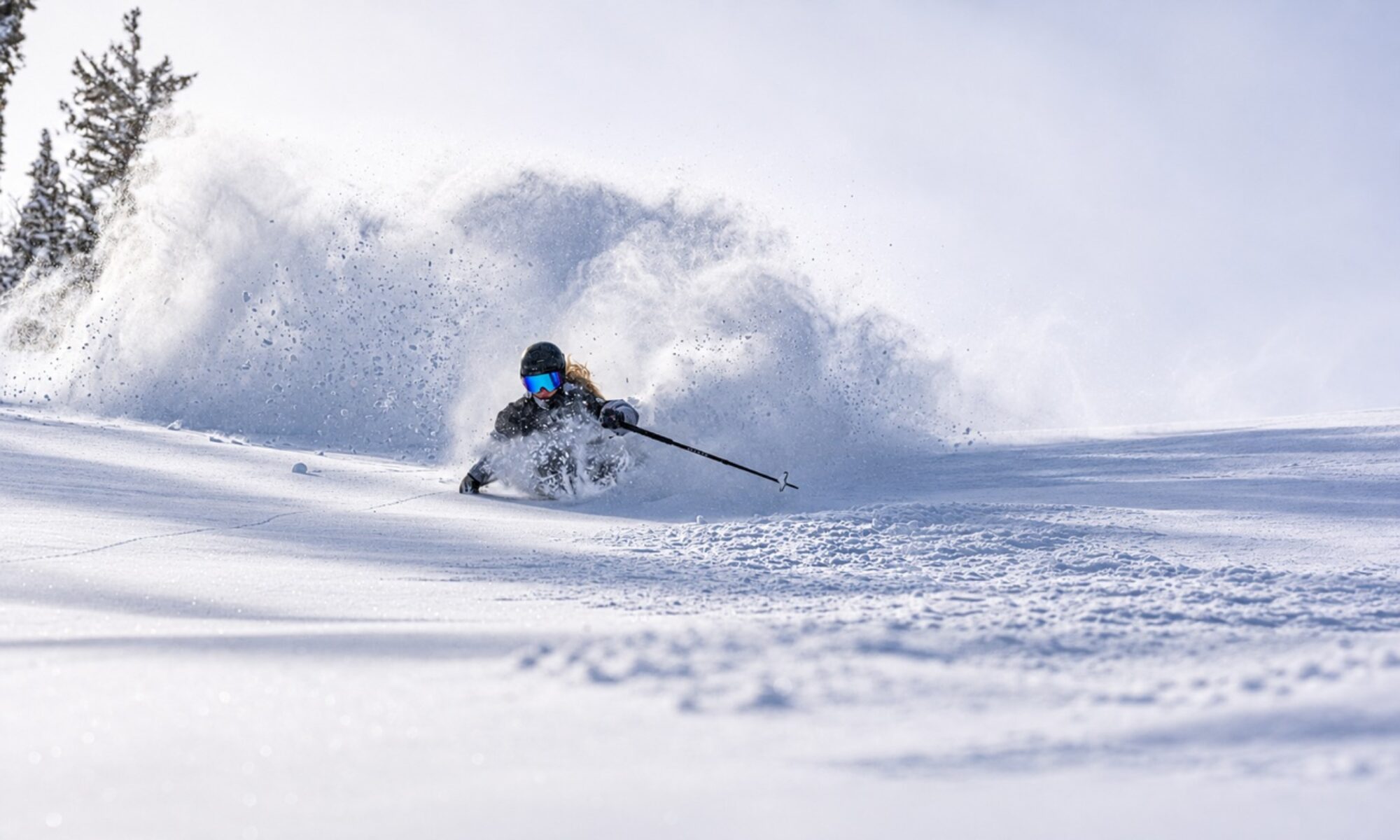

Rhoda Blake takes her rightful place in the New Mexico Ski Hall of Fame
By Ellen Miller-Goins
When people tell the story of Taos Ski Valley, the name that usually comes first is Ernie Blake.
He was the irrepressible promoter with the German accent, the pilot who spotted the snowy mountains near Wheeler Peak from the air and the man who imagined that a remote mining canyon without electricity, telephone service or much of a road could become a ski area.
But Rick Richards, who grew up knowing Ernie and Rhoda Blake and later chronicled the beginnings of Taos Ski Valley in his 1992 book, “Ski Pioneers: Ernie Blake, His Friends and the Making of Taos Ski Valley,” says that version of the story leaves out half of the equation.
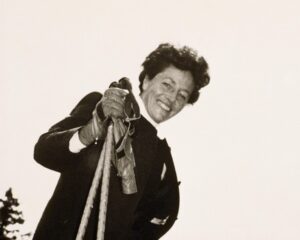
“Rhoda was as important as Ernie in making that thing work, and that’s really the truth,” Richards says. “It would not have happened without Rhoda.”
This fall, the New Mexico Ski Hall of Fame is recognizing that.
Rhoda Blake, who died in 2015 at age 97, was inducted into the Hall of Fame in October. The organization describes her as playing an “essential role” in Taos Ski Valley’s development, providing the resilience, leadership and support that helped carry the fledgling operation through its formative years.
It is recognition Richards believes should have come long ago.
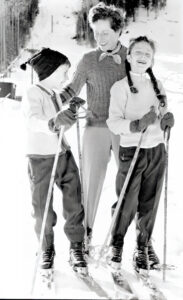
Ernie Blake was among the New Mexico Ski Hall of Fame’s first inductees in 2003. Rhoda followed in 2004, but as an “Honorary Member,” a distinction Richards came to believe failed to recognize what she had actually accomplished. The Hall of Fame’s own 2004 biography detailed some of those accomplishments: She mounted bindings, converted surplus Army skis into rentals, became the ski area’s explosives expert, drove on the mountain, established the rental and retail shops and laid out early roads and trails.
Unlike her 2004 recognition as an “Honorary Member,” the 2026 class lists Rhoda Blake among its Hall of Fame inductees.
Richards began trying to change Rhoda’s status about two and a half years ago. He spoke with her son Mickey Blake, who supported the effort, and gathered letters from family members and others.
“I’m just very happy for her,” Richards says. “She so deserves it.”
Mickey Blake credits Richards with making it happen.
“Rick Richards was the one that said, wait a minute, you need to recognize some of these people who actually did the work and were not up front,” Blake says.
For Rhoda, “actually doing the work” could mean almost anything.
Trading Park Avenue for adventure
Born in London in 1918, Rhoda was orphaned by World War I and adopted at age 3 by Herbert and Irma Limburg of New York. She attended the Dalton School and briefly attended Bryn Mawr before studying art at Columbia. The genteel society life envisioned for her held little appeal.
In a 1999 interview I did with Rhoda for the Sangre de Cristo Chronicle, she remembered the social calls she and her sister were expected to make with their mother.
“I can’t say I ever enjoyed it,” she said. “My sister and I would have to dress up in our Sunday best and accompany our mother as she visited her friends, never ours, praying all the time those ladies wouldn’t be at home.”
At 21, Rhoda and a friend persuaded their parents to let them spend a summer in Santa Fe, supposedly to study art. They continued on to Mexico City in a convertible, were robbed and ended up sleeping in a field when they ran short of money.
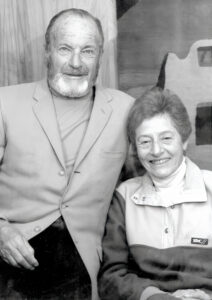
Then, during the Christmas holiday in 1940, Rhoda met a Swiss-German immigrant named Ernst Hermann Bloch while skiing at Stowe, Vermont. They married in 1942.
Rhoda always called him Ernest. The rest of the world would come to know him as Ernie.
During World War II, while living in the San Francisco Bay Area, Rhoda worked at Alameda Naval Air Station repairing PBY Catalinas, the amphibious aircraft known as flying boats. Mickey Blake says she worked on aircraft damaged in the Pacific, helping put them back into service. Her family called her “Rhoda the Riveter.”
That mechanical aptitude would prove useful in the mountains of Northern New Mexico.
‘Why not do something you love?’
After the war, the Blakes settled for a time in Connecticut, with Ernie commuting to work in New York.
Rhoda wanted something different.
“I told him, ‘You spend most of your life working, why not do something you love?’” she recalled.
Eventually they came west. Ernie managed the Santa Fe Ski Basin, and on flights between Santa Fe and a Colorado ski area he became intrigued by the snow-covered mountains near Wheeler Peak.
By 1955, Ernie and Rhoda had brought their three children, Mickey, Wendy and Peter, to Twining, the former mining settlement that would become Taos Ski Valley.
The odds were not encouraging.
There was no electricity. No telephone. The road was primitive. The family squeezed into a small trailer, and the ski business itself was hardly a proven way to make a living.
“We just felt that if you’re going to work 16 hours a day, you might as well work for yourself,” Rhoda recalled.
Five people lived in the trailer. There was no plumbing. Mickey slept in a bed Rhoda built above his parents’ bed; Wendy and Peter slept on a table. When overflow guests from the Hondo Lodge slept on cots in the trailer’s tiny passageway, the family sometimes couldn’t get out of bed until the visitors got up.
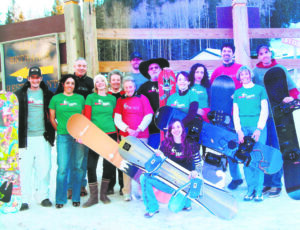
Three generations of Blakes celebrate the arrival of snowboarding at TSV on March 18, 2008.
The hardships could be comic. Rhoda remembered the trailer door freezing shut. Once, she shoved it so hard she flew outside into the snow. Peter looked out and said, “Mommy, do that again!”
Richards still marvels at what the Blakes attempted.
“To think that Ernie and Rhoda thought that they could create a ski area in Twining Canyon with no road, no electricity, no telephone was absolutely basically insanity,” he says.
But they did it.
While Ernie became the public face of the mountain, Rhoda became one of the people who made the machinery of the dream work.
‘I did the mechanics’
In the earliest years, there was little room for job descriptions.
The Blakes ran lifts, sold tickets, rented skis, fitted boots, taught lessons, cooked meals, washed dishes and kept fires burning.
Rhoda did considerably more.
She helped build the Poma lift. She mounted rental skis. She painted and built things. She patrolled. She groomed trails and helped lay out new ones. When Porcupine became badly moguled, she and Walter Widmer headed out with infantry spades, knocking the tops off the bumps and stomping down the snow.
The division of labor between husband and wife was not conventional for the 1950s.
“I always said we had a very backward marriage because I did the mechanics and he wrote the letters,” Rhoda said.
She knew what Ernie could do better than almost anyone.
“He wasn’t good with his hands but he was a genius with people,” she said. “He made everybody who came here feel they were his long-lost friend. He was also a genius at publicity.”
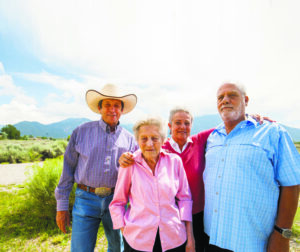
Peter Blake, Rhoda Blake, Wendy Stagg and Mickey Blake. The family that started Taos Ski Valley with Ernie Blake.
Others saw the same partnership. Wendy Stagg once put it more bluntly: “There would be no TSV without her. Ernie was a marketing genius but could barely change a light bulb, much less mount skis, build buildings, etc.”
In the family’s telling, Ernie laid out the steep trails. Rhoda laid out the easier ones. She operated the rental and retail side of the business for years. Her mechanical ability extended to jobs few people would associate with the quiet woman who generally avoided the spotlight: The Hall of Fame biography notes that she became Taos’ explosives expert for blasting rocks and stumps.
She also became a skilled ski instructor, particularly adept at coaxing frightened beginners down the mountain.
She was a skier and racer, too. Richards says racing was an important part of the early ski culture, and Rhoda took part alongside the other pioneers.
Once, she recalled, she taught a group of football players who repeatedly fell and needed help getting back onto their feet.
“Can you imagine lifting 200 to 300-pound people up for two hours?” she said. “I was exhausted.”
A partnership
Richards believes Rhoda’s contribution went deeper than the physical work. She helped make it possible for “Ernie to be Ernie.”
Rhoda brought some financial resources to the marriage, Richards says. That support helped give Ernie the freedom to pursue the fledgling ski industry, operate the Santa Fe Ski Basin, fly between New Mexico and Colorado, and develop relationships with the relatively small circle of American ski pioneers.
“She helped him financially,” Richards says. “People didn’t realize that back then.”
She was also his sounding board.
Richards says Ernie was the personality, while Rhoda preferred the background. Through his interviews for “Ski Pioneers,” he learned that when an important decision had to be made, Ernie consulted Rhoda.
Richards calls it a “true partnership.”
Ernie himself acknowledged it.
In “Ski Pioneers,” he said, “Taos Ski Valley succeeded because she was with me…. She thought this idea of a ski area was a good one, this crazy idea which couldn’t make money.”
For a long time, it didn’t.
Rhoda recalled that Taos Ski Valley did not make money for roughly its first 18 years. Whatever it earned went back into the mountain.
But the tiny ski hill grew.
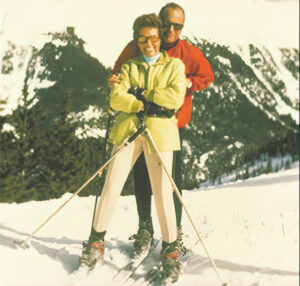
COURTESY PHOTO
By the time Rhoda died in 2015, the experiment she and Ernie began in an isolated canyon had become internationally known. Yet public attention had always fallen more naturally on her gregarious husband.
Rhoda seemed comfortable with that.
“She was always so quiet,” longtime ski instructor Max Killinger recalled after her death. When Ernie entertained guests at their Taos Ski Valley apartment, Killinger said, Rhoda might retreat to the bedroom rather than join the gathering. “She really enjoyed her privacy.”
Reserved, however, did not mean inconsequential.
“She had just as strong a personality as Ernie,” Peter Blake said in 2020. “She was just more reserved.”
That distinction may help explain why it took so long for Rhoda’s role to receive the same kind of recognition.
Mickey Blake is glad to see the focus broaden beyond the people who stood in front.
“I’m really glad to see them honor the people like my mom that mounted endless rental skis,” he says.
More than seven decades after Rhoda Blake helped turn a rough mining canyon into a ski area, the woman who fixed what broke, built what was needed, taught people to ski and helped give Ernie Blake the freedom to dream is finally being recognized not merely as the woman beside the founder, but as a ski pioneer in her own right.