
Taos is building the connections, spaces and skills to grow a filmmaking community
By Ellen Miller-Goins
For decades, Taos has had what filmmakers dream about: big skies, mountain light, adobe villages, high desert, alpine forests and views that can look both timeless and otherworldly.
Those landscapes have long drawn cameras. Films and television productions have used Taos and the surrounding country for everything from Westerns to road movies, science fiction and contemporary drama. “Easy Rider” filmed at Taos Pueblo, Manby Hot Springs and the Taos jailhouse, while “Twins” used the Rio Grande Gorge, the Sun God Motel and Mabel Dodge Luhan House. The Rio Grande Gorge Bridge later appeared in “Natural Born Killers” and “Terminator Salvation.”
What is changing now is the emphasis. The question is no longer simply whether a production can film Taos. It is whether films can be made from Taos, with local spaces, local crew, local students and local organizations helping move projects from idea to screen.
A soundstage. Trained crews. Production support. A film office. Places for young filmmakers to learn their craft, meet professionals and make the leap from a classroom project to a paying job.

Those pieces are beginning to connect.
Over the past two years, a group of organizations and filmmakers has begun building something closer to a filmmaking ecosystem. 7K Studios has opened a production facility in the former St. Francis Catholic Parochial School in Ranchos de Taos. UNM-Taos is expanding its Film and Digital Media Arts program and preparing for a much larger workforce center. The nonprofit Taos Film Office is working to attract productions and build a database of locations and local crew. The Taos 48 Hour Film Challenge is giving people a reason to pick up a camera and make something. And after a successful inaugural event in 2026, the Taos Film Festival returns in spring 2027.
No one is claiming Taos has suddenly become Hollywood in the high desert. Steady production work, funding and some basic infrastructure remain significant hurdles.
But something is taking shape.
“I think it’s a combination,” Taos Center for the Arts Executive Director Chelsea Reidy says, describing both new activity and stronger connections among people and organizations that have worked for years to create a filmmaking community.
The inaugural Taos Film Festival made those connections visible. TCA, 7K Studios, UNM-Taos, True Kids 1 and other arts organizations and venues participated.
“There is depth, energy and real interest about movies and making movies,” Reidy says. “And there’s a strong history of filmmaking and film festivals in Taos and the region.”
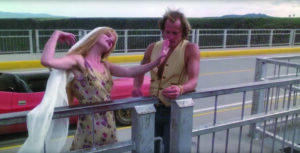
Psychopathic serial murderers Mallory and Mickey (Juliette Lewis and Woody Harrelson), perform their own marriage ceremony on the Río Grande Gorge Bridge in the 1994 film Natural Born Killers directed by Oliver Stone.
A place to make things
When Jenny Natelson and Sayer Danforth started thinking about 7K Studios, the question was surprisingly basic.
“Where does that get done in this town?” Danforth recalls asking.
The answer, essentially, was nowhere.
“So that’s kind of the initial thinking of it,” he says.
Both came from production backgrounds. Natelson, who grew up in Taos before leaving to study and work in commercial film production, returned with an idea for something she did not have growing up: a local place where people could encounter filmmaking as an actual profession. The former parochial school in Ranchos de Taos became 7K Studios, with production space, offices, edit bays and a 5,500-square-foot soundstage.
The studio opened April 25, 2026, during the first Taos Film Festival.
Almost immediately, Taos began showing Natelson and Danforth that the building could be more than a place to shoot movies.
People approached them about art exhibitions, fundraisers, performances, DJ events, PechaKucha gatherings and other uses. The studio has hosted photo and video shoots, a fashion show and community events. During a Taos 48 Hour Film Challenge, 7K donated space where participants could film or edit their projects.
“We are a place for creatives to come and do what they want,” Natelson says. “Come to us with your ideas. We’ll help you, or, you know, shoot your movie here. We’ll help you.”
The long-range goal, however, remains film.
7K is developing the property in phases. Natelson says the five-year vision is a fully functioning film campus. Plans include additional improvements to the soundstage and green room and eventually converting the former nunnery on the property into lodging where a small production or members of a crew could stay while working on-site.
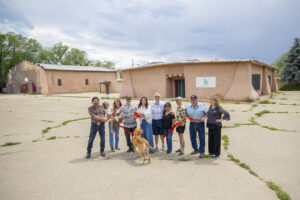
CLEMENTINE MILLER/Taos News
Danforth sees an advantage in offering something different from the large studio facilities in Albuquerque and Santa Fe.
Taos, he says, can offer the experience of the place itself: filmmakers can work in a studio, stay nearby and then go out into the landscape to shoot.
Putting Taos on the location map
That landscape is precisely what Jonathan Slator hopes to sell.
Slator heads the nonprofit Taos Film Office, which began operating in summer 2026. A longtime film professional and location manager, he has worked in the industry for decades, with credits that include “Hell or High Water,” “Transformers,” “The Avengers,” “Thor” and “Maze Runner: The Scorch Trials.”
His pitch to producers starts with something practical: He knows how productions work and how to find what they need.
Slator says the film office can provide initial professional location scouting at no charge while building a database of Taos-area locations, crew members and production resources.
The possibilities range from high desert and canyons to ranches, cabins, adobe buildings, churches and alpine country. The film office’s mission is not simply to bring cameras here but to use production as an economic and workforce-development tool.
For a production company, however, beautiful scenery is only the beginning.
A film might need dozens of hotel rooms, transportation, catering, laundry service, road access, permits and cooperation from law enforcement or emergency services. A production scouting two equally compelling locations may choose the one where those needs are easiest to meet.
That is one reason Natelson considers a film office so important.
“A film office is pretty crucial for bringing film and production here,” she says.
The larger ambition is to create an industry that circulates money through the community. A production does not spend only on cameras and actors. Crews sleep in hotels, eat in restaurants, rent vehicles, hire drivers, buy supplies and employ local workers.
“It’s not just our business that would benefit from that,” Natelson says of attracting productions. “It’s all the people that work in the production industry that would benefit that live here. It’s the economy of Taos. It’s the hotels. Restaurants, the private sector, car rentals, transportation.”
From classroom to set
Of course, bringing productions to Taos only goes so far if there are not people here ready to work on them.
That is where UNM-Taos comes in.
Its Film and Digital Media Arts program teaches video production, animation, post-production editing, cinematography, directing, film studies and adventure filmmaking. Students also work on projects ranging from music videos and museum stories to mini-documentaries and event production.
Department Chair Peter Walker says students divide roughly between those determined to build careers in Taos and those eager to test themselves in larger markets.
The difficulty for those who want to stay is not necessarily a lack of talent or training.
It is a lack of steady jobs.
“We have yet to see any major studio or production organization able to offer full time consistent work in Taos,” Walker says. “Hopefully that day will come soon!”
One emerging filmmaker shows both the promise and the challenge. Isaiah Galante, 26, earned his Film and Digital Media Arts degree at UNM-Taos, then took those skills to Denver and Los Angeles, where he worked in film, commercials and music videos. His experience includes serving as Bass Pro’s resident filmmaker in Denver, working on three Super Bowl commercials and contributing to dozens of hip-hop videos across the country.
Galante has since returned to Taos and now works as an FDMA staff member supporting the program’s production arm. His recent short film, “Beyond the Clock,” follows childhood friend Jonah Vigil, a Taos track athlete pursuing the 2028 Olympics. His path illustrates what Walker sees among many students: Some will leave Taos to build larger networks and gain experience, but leaving does not have to mean leaving for good.
That makes relationships outside the classroom particularly important.
UNM-Taos students participate in film festivals, industry gatherings and projects with local organizations. Advanced students recently took part in a two-day production assistant training at 7K Studios, learning the communication protocols and practical skills needed on a fast-moving set.
The Taos Film Office and UNM-Taos are also developing plans for workshops taught by working film professionals, particularly in entry-level trades. Slator hopes experienced local grips, camera operators, electricians, set decorators and other crew members can pass their knowledge to people trying to enter the business.
The next major piece is physical. UNM-Taos plans to expand Film and Digital Media Arts into the former National Guard armory, envisioned as a Workforce Center with about four times as much space for productions, classes, events and collaborations. Walker describes it as a place where the Taos Film Office, visiting productions and hands-on classes can mix and where film students can work alongside other career and technical programs, including construction and culinary arts.
For filmmaking, that matters. A movie set needs far more than directors and cinematographers.
“The creative talent is here,” Walker says. “We have a strong foundation of professional organizations, film industry professionals, ambitious students, venues, studios and festivals.”
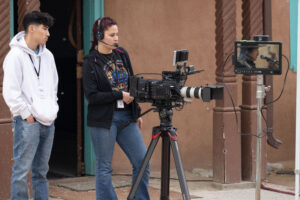
What Taos needs now, he says, are grants, funded productions ready to shoot here and continued support from the Town of Taos and Taos County.
Make a movie. You have 48 hours.
Not every filmmaking pathway needs to begin in a college classroom or on a professional set.
Sometimes it starts with a deadline.
In fall 2023, Taos filmmakers were challenged to write, shoot and edit a short film in just 24 hours. By spring 2024, organizers had become slightly more merciful: They gave participants 48.
The Taos 48 Hour Film Challenge has since become a recurring exercise in fast, collaborative filmmaking. Teams receive required elements and have a weekend to write, cast, shoot and edit a short film before the finished work goes on the big screen at TCA.
The goal is larger than competition.
Organizers describe the goal as “connection through the creation of films.”
That connection may be one of the most important ingredients in what is happening now.
A person can study filmmaking at UNM-Taos, make a movie with friends for Taos 48, meet other filmmakers at the Taos Film Festival, attend professional training at 7K Studios and potentially find work through relationships being developed by the Taos Film Office.
The pieces reinforce one another.
The missing pieces
There is still a considerable distance between an emerging filmmaking community and a self-sustaining film industry.
Reidy cautions that it could be years before Taos has enough consistent work for large numbers of locally trained people to earn their living entirely through film.
“There are enormous gaps when it comes to public or private support and infrastructure to directly support artists,” she says.
Natelson would eventually like to see a local film fund, something akin to other arts funding that could help Northern New Mexico filmmakers turn scripts and ideas into actual productions.
7K, she and Danforth emphasize, is not a film fund. It is a place where filmmakers can make a project once they have the means to do it.
That distinction may explain where Taos stands right now.
The community has filmmakers. It has students. It has teachers and veteran crew members. It has a studio, screening venues, a film festival and a grassroots filmmaking challenge. It has a fledgling film office working to make the area easier for outside productions to navigate.
What it needs next are projects.
And enough of them so a young filmmaker no longer has to assume that learning the craft in Taos eventually means leaving Taos to practice it.
Reidy offers one measure of what success might look like five years from now: multiple productions shooting around Taos each year, abundant training opportunities for local residents and funding and educational programs that help emerging filmmakers make their work.
Walker imagines graduates moving into professional careers, some building their own companies or becoming department heads and then returning to mentor the next generation.
For a community long accustomed to appearing in front of the camera, that would represent something different.
Taos would not simply be a place filmmakers discover. It would be a place where filmmakers are made.
Taos Film Festival returns in 2027
The second annual Taos Film Festival runs April 29-May 2, 2027, building on an inaugural festival that brought filmmakers, audiences and arts organizations together across Taos in April 2026.
A project of the Taos Center for the Arts, the festival showcases independent filmmaking from New Mexico and around the world, with feature-length and short narrative and documentary films as well as experimental, animated and international work. Screenings are accompanied by filmmaker Q&As, talks and creative workshops.
The inaugural 2026 festival screened 150 films from regional and international filmmakers at multiple venues and included locally focused programming, talks, parties and Q&As.
2027 festival: April 29-May 2
Main venues: Taos Center for the Arts, Harwood Museum of Art and WildFlower Playhouse
Film categories: Narrative shorts and features; documentary shorts and features; experimental shorts; international shorts and features; animation shorts and features
Submission deadlines: Final deadline, Dec. 15, 2026; extended deadline, Jan. 15, 2027; notification, March 1, 2027. New Mexico filmmakers and films shot primarily in New Mexico qualify for submission fee discount codes.
Festival website: taosff.org