
Contemporary artists explore adobe’s past, present and future
By Ellen Miller-Goins
Walk into the Harwood Museum of Art this winter and one of the most familiar materials in Taos may suddenly look different.
Mud becomes sculpture. Adobe walls become passages, archives and gathering places. A century-old wall hidden inside the museum is exposed. Elsewhere, adobe is paired with radio technology, video and even robotic 3D printing.
That transformation is at the heart of “Unearthing Futures / Desenterrando Futuros,” the Harwood’s ambitious exhibition devoted to adobe as both an ancient building practice and a contemporary art material. Running through Feb. 28, 2027, the exhibition brings together works from artists including Gabriel Chaile, rafa esparza, Santino Gonzales, Joanna Keane Lopez, Ronald Rael, Christine Howard Sandoval, Carole Crews, Deborah Lujan, Daniel Barela, Harry Chavez, Johnny Coca, H. Warren Kelly, John Andrew Martinez, Ruby Mondragón, James Valerio, Michael Valerio and Pacomio Valerio.
Adam Geluda Gildar co-curated the exhibition with Nicole Dial-Kay, the Harwood’s curator of exhibitions and collections.
For visitors accustomed to seeing adobe throughout Taos, the show asks for a second look.
“When visitors enter the exhibition, my hope is that they feel moved by raw earth,” Gildar says. “I hope they’ll experience its potential as a radically imaginative material.”
The works range from imposing architectural forms to details and stories embedded in the material itself. Gildar hopes that placing adobe in an art museum encourages visitors to approach both the material and the cultural traditions surrounding it with “reverence, curiosity and excitement.”
That is particularly resonant in Northern New Mexico, where adobe is hardly an exotic medium. Earth, water and natural fiber have been shaped into homes, churches and other structures here for generations. Globally, earthen building stretches back roughly 10,000 years and appears on nearly every continent.
Yet Gildar says that before this exhibition, adobe had not been the subject of a museum exhibition devoted specifically to its use as a contemporary art material.
“What may surprise visitors is how the works connect reverence for heritage adobe-building practices with inventive physical and conceptual approaches to working with it as an art material,” he says.
A museum remade in mud
“Unearthing Futures” is unusually physical. Rather than simply placing objects inside the Harwood, several artists have altered the way visitors experience the building itself.
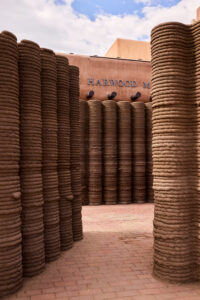
Ronald Rael’s “LIMINAL,” made from 3D printed adobe, creates a winding entrance of earthen walls. Gildar describes it as a welcoming, maze-like gateway that deliberately slows visitors on their way into the museum. There are places to sit and gather, and a traditional horno is incorporated into the structure for cooking and communal meals.
The juxtaposition is central to the exhibition: one of humanity’s oldest construction materials shaped with contemporary digital technology.
For Gildar, Rael’s work suggests that tradition and technological invention do not have to exist in opposition.
“In Rael’s architectural sculptures, I see a vision of hybridity and sustainability,” he says, describing the work as renewing ancient material knowledge through contemporary inventions that can expand structural and aesthetic possibilities while reducing labor.
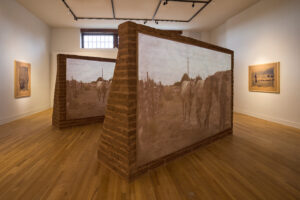
rafa esparza also transforms the museum with “one day the machines stopped…,” turning a conventional gallery into an adobe tunnel that changes how visitors move through the space.
Look closely at the wall
Amid the monumental installations, one of Gildar’s recommendations for visitors is almost startlingly simple.
Slow down in front of “Vislumbre del Horizonte,” a collaboration between esparza and Rael.
The artists cut a horizontal band through the stucco of a Harwood wall, exposing the museum’s original 1916 adobe construction underneath. Directly across from it is the permanent Agnes Martin Gallery, with Martin’s paintings built around delicately colored horizontal lines.
The intervention becomes its own horizontal line, but this one reveals what the building has concealed.
Gildar calls the gesture “radical and subtle.” For him, the discovery that the century-old adobe remained intact also turns the work into something larger than architectural archaeology.
“The title speaks to a glimpse of the horizon,” he says, “which indicates that it’s not only a look backward at a buried past, but serves as a radical gesture that points to a future in which the connection between people, earth and the buildings we live in might be reinvigorated.”
That interplay between past and future runs throughout the exhibition.
Santino Gonzales combines adobe with radio and sound technology. His “Adobe Radio” begins with recorded memories from his own family and invites others to call in and contribute their stories. Those personal histories can then travel far beyond the places where they originated.
Joanna Keane Lopez takes another approach. Her “Energetic Materials” combines two-channel video, adobe and soil gathered from an arroyo in the Northern Call-Up Area of White Sands Missile Range, along with photographic elements, to examine histories of land use and militarization in New Mexico’s Tularosa Basin.
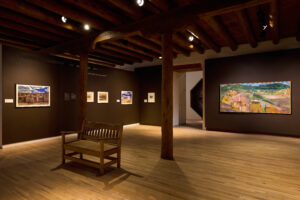
Christine Howard Sandoval similarly uses adobe as a means of examining history. Her work traces connections among acequias, missions and dams, allowing the material itself to crack and shift rather than treating earth as something inert or fixed.
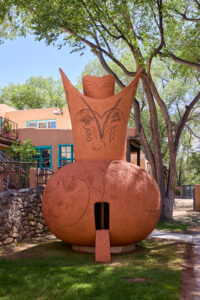
And Argentine artist Gabriel Chaile pushes adobe toward the monumental, drawing on horno traditions and zoomorphic ceramic lineages of northern Argentina to turn an earthen vessel into a sculptural form associated with food, gathering and collective life.
Built through relationships
Despite the exhibition’s scale, its roots are local and personal.
Gildar and Dial-Kay wanted the process of creating the show to reflect what Gildar calls the “inherently relational qualities of adobe building.” Artists came together in Taos and the San Luis Valley, visited historic adobe sites and spent time with people who continue the region’s traditions.
Those visits included San Francisco de Asís Church in Ranchos de Taos, Hacienda de los Martinez, Taos Pueblo and other historic sites, where artists encountered generations of knowledge about earth, building, labor and maintenance.
That community knowledge also enters the museum directly.
Guadalupe Tafoya, historian and archivist of San Francisco de Asís Church and a descendant of generations of enjarradoras, curated a gallery devoted to Hispanic traditions, incorporating work by artist parishioners with historic pieces from the Harwood collection. Artist Deborah Lujan of Taos Pueblo curated another gallery, presenting her own photographs of Taos Pueblo alongside selections from the museum’s collection.
The approach complicates the notion of adobe as a relic of the Southwest’s architectural past.
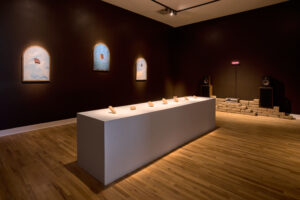
Adobe survives precisely because it is not permanent. It requires hands. It must be repaired, replastered and renewed. In that sense, the material carries both history and an obligation to the future.
For Gildar, that may be one of the exhibition’s most important ideas. Although the artists work with essentially the same substance, he says, each proposes a different possibility for what it can become.
“There is also a through line of adobe as a material rooted in relationships between people and the earth,” he says. “I think all of the artists share a relationship with mud as a vehicle of time travel that spans past, present and future.”
Visitors may leave the Harwood looking differently at the mud walls all around Taos: not simply as evidence of what has survived, but as something continually being made.
And Gildar has one more argument for winter visitors wondering whether to add the museum to their itinerary.
“Adobe is a great insulator!” he says. “Come visit!”
Harwood Museum of Art
238 Ledoux St, Taos, NM 87571
Open Wednesday-Sunday 11 a.m.-5 p.m.