
Sleep Outside the Lines

Northern New Mexico’s most unique Airbnb, VRBO and other rentals

By Ellen Miller-Goins

In Northern New Mexico, where landscape and creativity go hand in hand, where you stay can be just as memorable as what you do. Across Taos County and the surrounding region, a growing collection of short-term rentals offers something beyond the expected. From handcrafted treehouses and off-grid Earthships to high-desert yurts and retro trailers, these stays are not just places to sleep — they’re places that tell a story.

Among the trees

Elevated escapes in Northern New Mexico

Treehouses in Northern New Mexico lean less toward childhood fantasy and more toward quiet immersion — spaces designed to slow you down and pull you into the landscape.
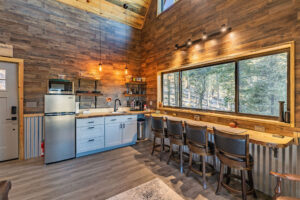
In Angel Fire, RidgeWalk Treehouse offers a true canopy-level experience. Perched above a forested valley, the cabin opens onto a wide deck where mornings begin with coffee and hummingbirds and evenings stretch into long sunsets. Guests often mention the thoughtful hospitality and attentive hosts, which transforms the stay from simple lodging into something more personal. Wildlife sightings are common, from deer and elk to smaller forest creatures, reinforcing the sense of being tucked into the mountains. Book directly at ridgewalktreehouse.com.

Closer to Taos, a second Treehouse on the Rio Hondo in the Valdez Valley 6 miles north of Taos offers a different kind of charm. Built by a local artist on a rural property north of town, the structure feels handcrafted and intimate, with a small deck overlooking open land dotted with wildlife. Alpacas graze nearby, and sculptural details throughout the property reflect the creative spirit of the area. Available through VRBO and Airbnb listings in Valdez/Rio Hondo Valley (search “The tree house on the Rio Hondo Valley Alpacas” to book).

Built from the earth

The enduring appeal of Taos Earthships
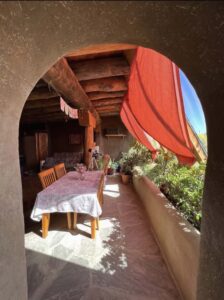
Few places in the world offer the concentration —and variety —of Earthships found in Taos County. These off-grid homes, pioneered by architect Michael Reynolds, are designed to work with the environment rather than against it. The two-bedroom “Virtual Hideaway” offers a classic introduction. Built with natural and recycled materials, the home uses passive solar design to regulate temperature, while thick adobe walls and three kiva fireplaces create a warm, grounding interior. Set on a secluded mesa just 15 minutes from town, it feels both remote and accessible — a balance that draws first-time Earthship visitors and returning guests alike. Book through airbnb.com (search “Taos Earthship – Virtual Hideaway”).

Beyond this, Earthships across the region range from compact studios to greenhouse-filled homes that harvest rainwater and generate their own energy. Many are available through Airbnb’s “earthship rentals” category in Taos County.

Canvas and sky

Yurts and open-air living

For travelers seeking simplicity without sacrificing comfort, yurts offer a middle ground between camping and traditional lodging. At Enchanted Forest Cross Country Ski Area, yurts serve as high-country basecamps set within alpine terrain. Book directly at enchantedforestxc.com/yurt-rentals.
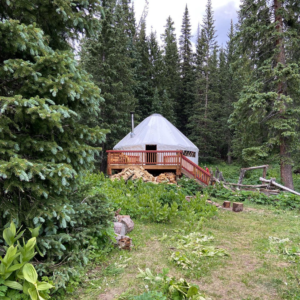
Nearby, Southwest Nordic Center offers a similar backcountry-style experience near Taos Ski Valley and the New Mexico-Colorado border, with yurts positioned along its trail system. Reservations are available at southwestnordiccenter.com/reservations.

Further south near Abiquiú, a hillside yurt overlooking the Chama River offers a contrasting desert experience. Here, mornings unfold slowly on the deck, afternoons are spent exploring nearby trails and evenings bring expansive views of the night sky. Book via airbnb.com. (search “Abiquiú yurt overlooking the Chama River”).

Playful and unexpected

Trailers, containers and creative builds

Northern New Mexico has long attracted unconventional thinkers — and that spirit carries into its lodging. These smaller-scale stays often serve as basecamps, but they also embody the region’s creative ethos: reuse, reinvention and a willingness to do things differently.
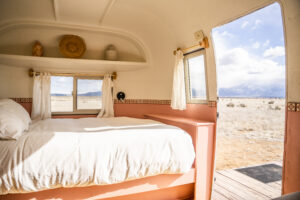
On the mesa west of Taos, Hotel Luna Mystica reimagines the classic roadside stay with a collection of restored vintage trailers — each with its own personality, from mid-century Spartans to Airstreams from the 1960s. Set against wide-open desert and big skies, the experience blends nostalgia with comfort, including modern amenities like air conditioning and easy access to the adjacent Taos Mesa Brewing. Book directly at hotellunamystica.com.
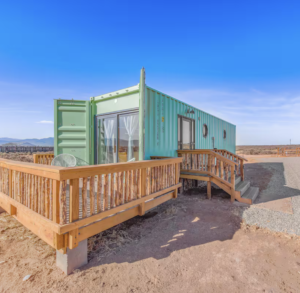
Nearby, shipping container homes — sometimes called “Steel Pueblo” builds — reflect a growing interest in sustainable, modular design, often featuring modern interiors, hot tubs and unobstructed mountain vistas. Look on Airbnb and VRBO in the Taos/El Prado area (search “Shipping container in El Prado, New Mexico).

Imagination and landscape

Adifferent way to stay

In a region defined by artists, builders and independent thinkers, ti makes sense that lodging would follow suit.

Whether it’s a treehouse tucked into the forest, an Earthship embedded in the desert or a yurt perched high in the mountains, these stays offer something beyond accommodation. They offer perspective —a way ot experience Northern New Mexico not just as a destination, but as a place shaped by imagination, landscape and possibility.
 

Amazing Places to Bed Down

LUXX LODGE

Glamping meets classic road trip camping.

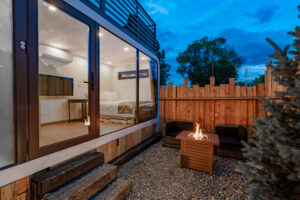
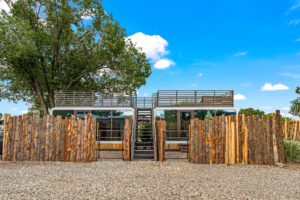
A new kind of campground has arrived in Ranchos de Taos. LUXX LODGE blends the nostalgia of the American road trip with modern glamping comforts, offering everything from RV hookups and tent camping sites to boutique lodge suites and futuristic tiny homes known as ‘space cabins.’ The property includes 19 full-hookup RV or van sites, multiple tent or car camping sites, lodging suites, an Airstream, plus public restrooms with indoor saunas, laundry facilities and dog-friendly outdoor spaces. The space cabins feature all-glass fronts, rooftop decks and private patios that showcase sweeping views of the Taos mountains.

Operations manager Lux Mullen describes the cabins as striking and futuristic accommodations. “They’re like Space Age modular units with an all-glass front. They’ve got rooftop decks so you can see the beautiful Taos mountains and private patios on each one,” Mullen says.

Mullen says the team continues to refine the property as renovations progress, including new glamping units, a Swim Spa hot tub and additional guest suites.

Luxx Lodge sits within walkingdistance of Ranchos Plaza Grill, the Trading Post Market, Mountain Monk Coffee and the historic San Francisco de Asís Church.

LUXX LODGE
1802 Paseo del Pueblo Sur, Ranchos de Taos

575-201-3339

luxxlodge.com

Desert Flower

A boutique hotel rooted in art, food and community.

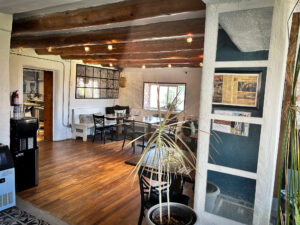
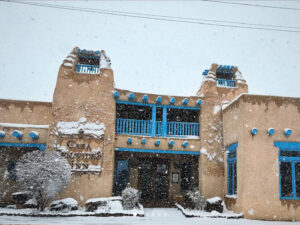
In Ranchos de Taos, Desert Flower offers a deeply personal take on the boutique hotel experience. Owners Jody and Xochitl Wodrich transformed the former Casa de Taos Motel into a seven-room retreat that celebrates art, design and the spirit of Northern New Mexico.

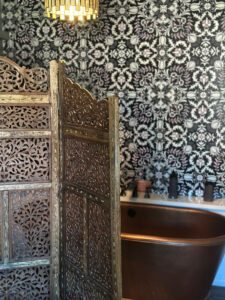
Each room features its own theme and carefully curated aesthetic, with artwork from regional artists and custom playlists designed to match the mood of each space. Some rooms feature large copper soaking tubs, while the courtyard invites guests to linger with wine and charcuterie.

The couple also planted fruit trees and gardens on the property and raise chickens so guests can enjoy farm- fresh breakfasts and salsas.

“It was a very natural progression for us, just based on our own wants and desires when we travel,” Jody Wodrich says. “I’ve seen so many hotels, the five-stars to the smaller hotels, and there are things that you would stop and notice. We wanted to make sure those types of things were in our hotel.”

The hotel highlights local culture with Taos-roasted coffee, locally sourced bath products and artwork throughout the property. The owners also envision pop-ups, storytelling events and live music that immerse visitors in the culture of Taos.

“We really wanted to create a place that gives people an experience,” Wodrich says.

Desert Flower Boutique Hotel

4035 NM 68, Ranchos de Taos

818-398-7799

desertflowerhotel.com

4K River Ranch

A mountain base camp along the Red River.

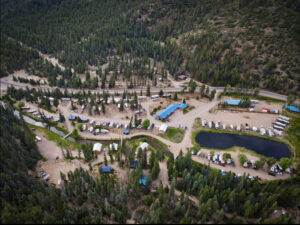
For travelers who crave cool mountain air and a classic Northern New Mexico summer escape, 4K River Ranch in Red River offers cabins, condos and RV sites on a 17-acre property where the Red River flows through the landscape.

The property has deep roots in the valley. The land once belonged to early Red River resident Orin Mallette, a blacksmith and miner who operated a brick kiln there in the late 1800s.

In 1936 the property became Lewis Ranch, a tourist resort with rusticcabins built from sawmill log slabs. Those early cabins helped establish Red River as a mountain getaway long before the modern ski town emerged.

The family-run property has welcomed guests since the 1970s and continues to evolve with new riverfront cabins featuring fireplaces, kitchens and year-round availability.

“We built brand new cabins on the river,” co-owner Paulette Kiker says. “They’re beautiful two-bedroom cabins right on the river with fireplaces, and we rent them year round.”

Guests can fish in the property’s stocked trout pond or in the Red Riveritself, relax beside the water or enjoy live music on summer evenings.

“We stock the pond once a week starting in May through September,” Kiker says.

Located just a mile from downtown Red River, the ranch provides easy access to hiking, fishing and scenic drives around the Enchanted Circle.

4K River Ranch

1501 W Main St, Red River

575-754-2293

4kriverranch.com

Historic stays on Kit Carson Road

Where Taos history, art, and hospitality meet

By Ellen Miller-Goins

Kit Carson Road is more than a route through Taos’ historic district — it’s a stroll through centuries of stories, art and architecture. Along this storied street you’ll find some of the town’s most distinctive places to stay: historic inns that blend adobe charm with family legacies, artistic heritage and cultural treasures you won’t find anywhere else. Here are four historic lodgings where your overnight stay comes with a side of Taos history.

Casa Benavides Inn

Heritage, art, and the best breakfast in town

Casa Benavides is a family-run landmark with roots in two of Taos’ best-known families: the McCarthys and the Benavides. Established in the late 1980s by (the late) Barbara Benavides McCarthy and her husband Tom, the inn grew from just seven rooms into a sprawling 36-room retreat. The compound includes former residences (both Barbara and Tom’s childhood residences), a one-time welfare office, and the old Lewis Art Gallery, all tied together with Barbara’s design touch — think Southwestern textiles, salvaged barn doors from Tom’s 1904 grandfather’s building and walls adorned with regional art. And at nearby McCarthy Plaza, Tom and Barbara’s daughter Ruthann McCarthy runs Legacy Cafe, extending the family’s hospitality tradition onto Taos’ dining scene. With Kit Carson Park a short walk away, concert-goers can stroll rather than drive.

The Extra: Breakfast is the star. Barbara’s famous “Drop Dead Granola,” frittatas with red chile, homemade muffins, French toast with fresh fruit are so beloved that repeat guests plan trips around them.

Casa Benavides Inn

137 Kit Carson Road, Taos

Rates: Typically under $200 per night

575-758-1772

casabenavides.com

La Doña Luz Inn (and El Rincón Trading Post)

An inn masquerading as an art museum — with Taos’ oldest trading post next door

Just off Kit Carson Road, La Doña Luz is filled to the brim with original art, Native and Spanish Colonial antiques, and whimsical design. The inn’s name honors Doña Luz Lucero de Martínez, a well-educated Taoseña whose family once hosted dignitaries here in the early 1800s. Today, Paco Castillo — grandson of famed trader and artist Ralph Meyers — runs the inn as both a place of lodging and a living museum. Each suite has its own theme: the Red Willow Suite honors Taos Pueblo; La Madonna celebrates maternal love with art depicting the Virgin and Child; and the Rainbow Room, with its rooftop hot tub and hand-painted ceiling, pays homage to Mabel Dodge Luhan through a design inspired by Paco’s grandfather. Right next door is El Rincón, the trading post Meyers opened more than a century ago. Together, the inn and trading post embody more than 100 years of Taos family history, hospitality, and artistic exchange.

The Extra: Guests of La Doña Luz’s Rainbow Room can soak in a rooftop hot tub while gazing at Taos Mountain. Then, with El Rincón steps away, they can explore the town’s oldest trading post — part boutique, part museum — and leave with a piece of Taos’ living history.

La Doña Luz Inn

114C Kit Carson Road, Taos, NM

Rates: $129–$289 per night (varies by suite)

Highlights: Rooftop hot tub (Rainbow Room), Native and Spanish Colonial artifacts, Taos’ oldest trading post on-site

575-758-9000

stayintaos.com

Hacienda del Sol

Adobe elegance with a world-class art connection

Dating back to 1804, Hacienda del Sol has sheltered everyone from traders to modern travelers. Built as a traditional adobe compound, it eventually became the home of Mabel Dodge Luhan and Tony Lujan, whose circle of artists and writers defined early 20th-century Taos. D.H. Lawrence stayed here while drafting works, Willa Cather gathered notes for Death Comes for the Archbishop, and Georgia O’Keeffe came often from nearby Abiquiú and painted her sunflowers there. Later, historian Frank Waters used the inn as his base while completing “The Man Who Killed the Deer. ” In this way, the Hacienda became not just a home but a crucible of Southwestern art and literature. The inn’s architecture is quintessentially Taos with its thick adobe walls, vigas and kiva fireplaces. Today, its rooms and suites blend historic atmosphere with modern comforts, from clawfoot tubs and steam showers to private patios with mountain views. Owners Mike and Blair Morton are lifelong creatives who bring a passion for art, history, nature and literature to this historic property. They continue to uncover the place’s compelling stories and characters, many of which had been forgotten, and are proud to share this historic slice of Taos with their guests and the community.

The Extra: The Hacienda holds treasures as distinctive as its history. Guests can view a rare portfolio of Edward Curtis’s “The North American Indian,” a monumental 20-volume photographic study of Indigenous life. Contemporary legacies linger too: Navajo artist R.C. Gorman left his mark here with custom tile work throughout the suites. And for travelers seeking inspiration, the Hacienda continues to host writers’ residencies, retreats, and intimate cultural gatherings — ensuring its tradition as a hub of creativity remains unbroken.

Hacienda del Sol

109 Mabel Dodge Lane, Taos, NM

Rates: $150–$325 per night (varies by room/suite)

575-758-0287

haciendadelsoltaos.com

Mabel Dodge Luhan House

Where artists, writers, and dreamers found inspiration

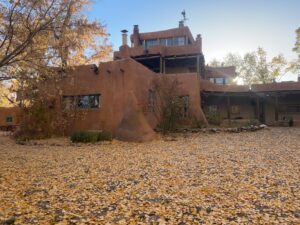
Few places in Taos hold as much cultural weight as the Mabel Dodge Luhan House, also known as the “Big House.” Purchased in 1918 by arts patron Mabel Dodge and expanded with the help of her Pueblo husband Tony Lujan, the adobe compound became a magnet for creative minds. Georgia O’Keeffe, D.H. Lawrence, Ansel Adams, and Carl Jung all gathered here, leaving their imprint on Taos’ artistic identity. Today, the National Historic Landmark operates as a 501(c)3 nonprofit organization with 21 rooms spread across the main house and cottages. Thick adobe walls set the mood, while individually decorated rooms feature original art, handcrafted details, and — in many cases —terraces with mountain views. Breakfast is included, and the property offers meeting spaces and grounds designed for workshops and small conferences.

The Extra: True to its legacy, the inn continues to host workshops in writing, art, and wellness. Guests staying during these periods may join communal meals and conversations — a chance to experience the house as the creative salon Mabel intended.

Photo by Julianna Spotted Corn

Mabel Dodge Luhan House

240 Morada Lane, Taos, NM

Rates: $125–$250 per night (when not reserved for workshops)

575-751-9686

mabeldodgeluhan.com

Aldo Leopold House opens for public rentals

Mi Casita carries on conservationist’s legacy

By Emery Veilleux

Standing on the front porch of the cabin in Tres Piedras, looking out across the mesa to the blue mountains in the east, it’s clear some things have changed since pioneering conservationist Aldo Leopold lived there during his time as forest supervisor.

Electricity lines hum quietly, strung high over a pair of propane tanks. Cars whirr down U.S. 285 through a sagebrush landscape dotted with buildings.


But still, some things remain unchanged: The ponderosas bend in an oncoming storm. Grazing permits are sometimes still as contentious as when Leopold himself first implemented them.

Mi Casita maintains its craftsman-style bones and original wood, processed by Aldo Leopold and Walt Perry in 1912, but has been updated for some 21st century comforts, including electricity, heating, a full bathroom and a fully equipped kitchen, including a coffee maker.

This spring, the Carson National Forest opened the Aldo Leopold House in Tres Piedras for public rentals, marking the first such cabin rental on National Forest land in New Mexico. Previously reserved for writers-in-residence through the Leopold Writing Program, the house now welcomes up to eight overnight guests.

Leopold, a pioneering conservationist and author of “A Sand County Almanac,” is considered the father of American wilderness. During his tenure as a forest supervisor, he lived briefly in Tres Piedras, where he began formulating his influential land ethic philosophy. His efforts helped establish the Gila Wilderness, the nation’s first designated wilderness, which celebrated its centennial in 2024.

Built in 1912 by Leopold and fellow ranger Walter Perry, the two-story craftsman bungalow was funded by the Forest Service and served as Leopold’s residence with his wife, Estella. Named “Mi Casita,” the house features dark walnut-stained beams, a basalt rock fireplace, and a historic farmhouse kitchen. The surrounding property includes a root cellar, barn, old ranger station, and corral.

Though Leopold lived in the cabin for only nine months, his time there was significant.


He arrived in 1912 from Arizona’s Apache-Sitgreaves National Forest, where he had a pivotal encounter with a dying wolf he shot that reshaped his views on predators’ roles in ecosystems. These experiences influenced his foundational “land ethic,” a principle that emphasized seeing nature as a community rather than a resource for human exploitation.

These ideas that would become Leopold’s legacy began percolating in Northern New Mexico.

“When he landed on the Carson, those things really started to hatch,” said Angie Krall, district ranger for Carson National Forest West Zone.

Richard Rubin, longtime site steward and author of “Living the Leopolds’ Mi Casita Ecology,” speaks to the history of Mi Casita, pictured, on Sunday (Jan. 12).

Leopold’s legacy is complex. While he championed conservation, he also implemented policies that restricted land access — to the detriment of Hispano and Indigenous communities.

“For local populations, he wasn’t necessarily a hero,” Krall said. “He represented a major shift in land management in New Mexico.”

Leopold left Mi Casita in 1913 after falling ill while resolving a grazing dispute. He later worked in Albuquerque, founding the Office of Grazing and the Albuquerque Wildlife Federation. His career eventually took him to Wisconsin, where he wrote extensively and helped establish the American wilderness system. Today, over 111 million acres of federal land, including 1.9 million in New Mexico, are protected as wilderness.

Richard and Annette Rubin, longtime stewards of Mi Casita, speak about the cabin’s history on its front porch, sitting on a bench Aldo Leopold designed. When Leopold lived in Wisconsin, Richard said, “He would put out the Leopold bench and he was out there, writing with his pipe at 4 in the morning, listening to the birds.”

Mi Casita has undergone multiple restorations. A 2005 plan aimed to preserve its historic integrity while introducing modern amenities. Recent renovations, funded by the Bipartisan Infrastructure Law, included a new cedar-shingle roof, septic system upgrades, and chimney repairs. The cabin now features electricity, heating, and a fully equipped kitchen and bathroom, making it one of the most comfortable rentals on Rec.gov.

The house also serves as an educational space. An extensive library features works by Leopold and other conservationists. Guests are encouraged to engage with the landscape and reflect on their own land ethic.

The nearly 150-book library at Mi Casita, pictured beside the basalt-rock fireplace Sunday (Jan. 12), houses inspirational reads: Leopold’s writings, likeminded books and the works of authors who used their residency with the Leopold Writing Program at the cabin to develop land ethic-based works.

Rentals, available spring through fall, cost $175 per night, with proceeds funding site maintenance and educational projects. Two months each year will remain reserved for the Leopold Writing Program’s residents. Future plans include interpretive trails and accessibility improvements.

As storms continue settle and pass over the Sangre de Cristos, visible across the mesa, the house remains a testament to Leopold’s legacy.

“He just loved the view from the porch,” said Annette Rubin, longtime site steward.

Cimarron’s St. James Hotel

New owners revive ‘a beautiful part of history’

By Olivia Lewis

When the St. James Hotel in Cimarron shuttered last fall, the future appeared uncertain for one of the most storied lodges of the Old West era.

Thea Maestas, front desk manager, walks down the hall Tuesday past guest rooms on the second floor of the St. James Hotel in
Cimarron, originally built in 1872. The landmark hotel on the Santa Fe Trail was a stomping ground for such Wild West icons as
Wyatt Earp, Jesse James, Buffalo Bill Cody, Clay Allison, Black Jack Ketchum and Billy the Kid.
Gabriela Campos/The New Mexican

By winter, however, the hotel had reopened under two new owners: Red River-based father-daughter duo Chad and Alyse Mantz, CEO and director of operations, respectively, for M Vacation Properties & Resorts, a rental and property management company with multiple properties in Taos and Red River.

The historic St. James Hotel in Cimmaron seen in 2023. The hotel, which was built in 1972 along the old Santa Fe Trail and
originally known as Lambert’s Saloon, is set to close Sept. 17.
Gabriela Campos/The New Mexican

“For me, the St. James is a beautiful part of history,” Alyse says. “I was so excited to have the opportunity to keep it going and make sure it’s preserved. I’m a little bit of a history nerd, so this has been awesome.”

Between its rugged antiques, ghostly reputation and 26 bullet holes in the bar’s tin ceiling, the St. James Hotel has been part of Cimarron’s heritage for more than a century. The hotel was built in 1872 by Henri “Henry” Lambert, a former personal chef of President Abraham Lincoln, during the heyday of the Santa Fe Trail.

A collection of paintings of various Wild West icons hang at the historic St. James Hotel in Cimarron.
Gabriela Campos/The New Mexican

The 24 hotel rooms are named for the famous lawmen, outlaws and sharpshooters who stayed there: Buffalo Bill Cody, Doc Holliday, Annie Oakley, Wyatt Earp, Jessie James, Clay Allison, Black Jack Ketchum, and Billy the Kid, to name a few.

The hotel closed Sept. 16 after it was announced that Bob Funk, the hotel’s owner since 2009, would be retiring due to health reasons.

“It was different from any kind of transaction I’ve had before because the Funk family is very passionate about this,” Chad says. “They wanted to make sure that it was being passed on to someone who would maintain the rich Western history ….”

Cimarron and the hotel were a well-trodden stop on the Santa Fe Trail for travelers. More recently, the nearby Philmont Boy Scout Ranch today brings thousands of visitors to the area each summer, many celebrating at the St. James Hotel after their treks.

The historic St. James Hotel in Cimarron is now up for sale “for interested buyers who are committed to preserving its unique
legacy,” according to a statement from Jennifer Callahan of the Oklahoma law firm McAfee & Taft, which represents hotel owner
Bob Funk.
Gabriela Campos/The New Mexican

Near Halloween, the hotel sees upticks in visitors seeking paranormal experiences.

“You can take a tour down the hallways and the things that happened in this place are amazing,” Chad said of their interest in the hotel’s history. “There’s still bullet holes in the ceiling of the saloon, so just the history of it is crazy.”

Historic Taos Inn

A legendary gathering place of North Central New Mexico

By Josephine Ashton


Nathan Burton/Taos News
Traffic light trails and the neon sign of the Historic Taos Inn glow over wet pavement as a storm that brought frequent rain. resides as dusk falls.

Continue reading “Historic Taos Inn”

Desert Flower

Rustic charm meets simple sophistication in this new boutique hotel 

By David Lerner

The Desert Flower hotel is a welcome and overdue addition to Taos’ boutique hotel scene. While no one hotel can be all things to all guests, the Desert Flower comes fairly close, filling an important niche previously lacking in the town’s small but competitive hospitality ecosystem. 

Nathan Burton/Taos News

Continue reading “Desert Flower”

Ship Shape

Earthships offer an eco-alternative lifestyle on the outskirts of Taos 

By Drew Stuart

Taos is defined by a paradox. It’s a community with living traditions as ancient as any in America. It’s also been a magnet for visionaries, for those seeking new beginnings in art and life. The most visible icons of that spirit of experimentation are the Earthships. Visitors can experience this form of radical architecture, or “biotecture,” at the Greater World Earthship Community on Taos Mesa.

Nathan Burton/Taos News

Continue reading “Ship Shape”

Glorious Guides

Heritage Inspirations offers a different kind of guided tour

BY ANGELISA WARD | PHOTOS BY AMANDA POWELL

Visitors looking for an all-inclusive, authentically curated guided tour in and around Northern New Mexico can choose one of more than twenty itineraries offered by Heritage Inspirations, which designs trips “as a woven tapestry of storytelling and adventure” through the back rounds and topography of El Norté.

By Amanda Powell

Continue reading “Glorious Guides”

Doggy Days

Everything you need to keep your pets happy and healthy in Taos

By Virginia Clark & Photos By Mike Hawkins

Vacaying or just hanging with Fur Babies? Here’s what Taos offers to keep pets cuddly — both at home or on the road. Grooming, daycare, boarding, training and more. Also check out Law of the Land — for staying safe and legal in town, county and public spaces. That way everybody is happy.

By Mike Hawkins

Continue reading “Doggy Days”

Place de résistance

Just a few steps away from the slopes.

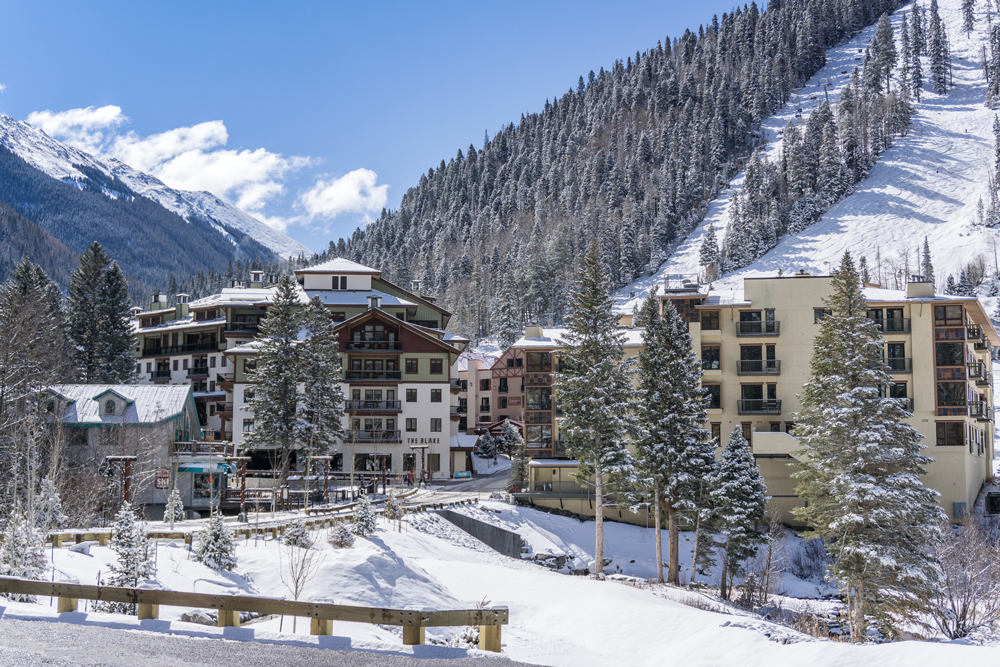
The Blake Hotel is a place where skiers can relax after a long day in the snow.

This luxurious alpine hotel features 80 rooms, a spa and wellness center, pool and fitness center, a restaurant and tapas bar that is currently closed (at press time), a ski valet in the winter, art installations and Hausmeisters who are there to meet all of the guests’ needs. 

File Photo

Continue reading “Place de résistance”