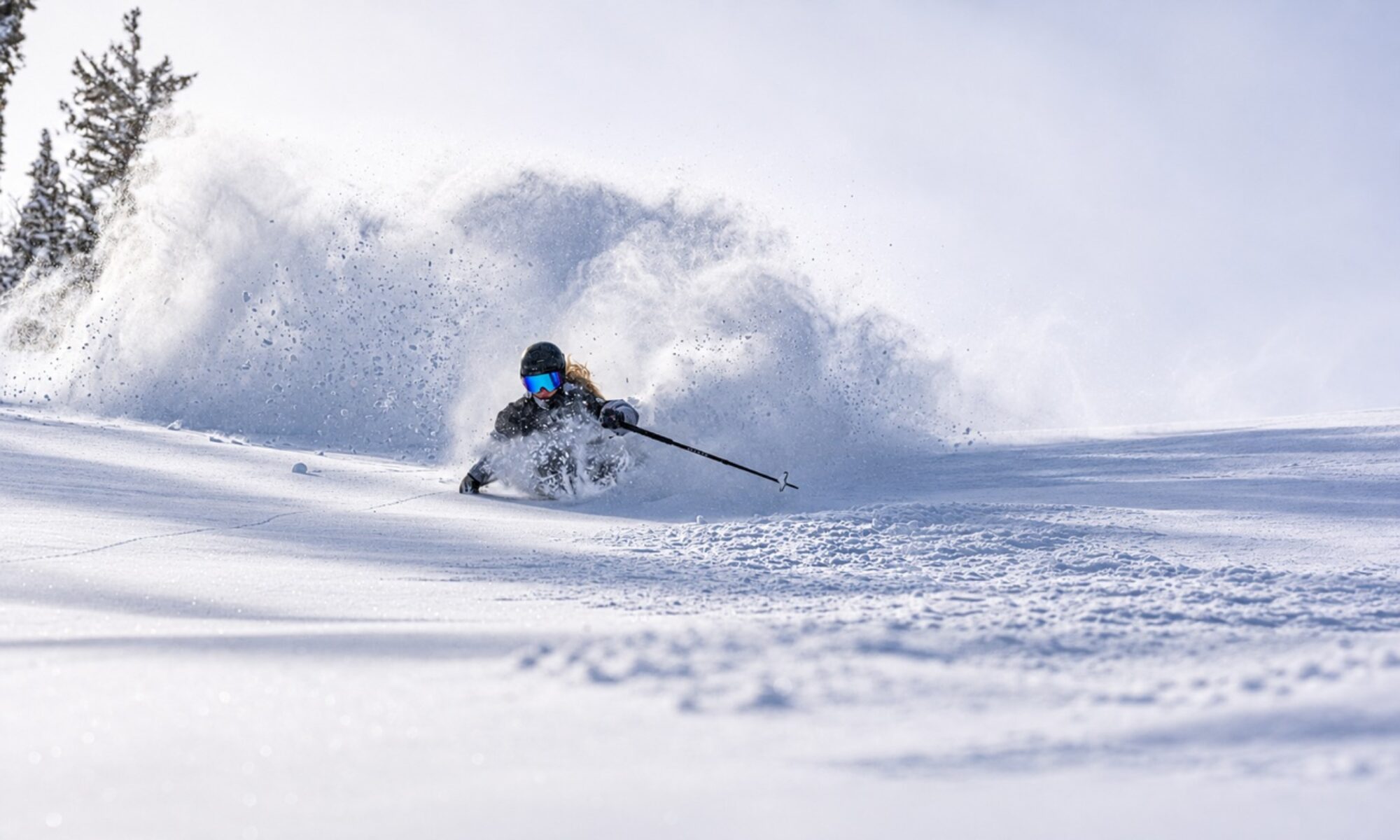

Seven feet of snow. Days of digging out.
By Ellen Miller-Goins
In early February 1989, snow piled so deep in Northern New Mexico that roads closed, school buses stopped and even ski operators struggled to cope. At Taos Ski Valley, some skiers weren’t about to let a stuck car keep them from the mountain.
“They left them right wherever they got stuck,” recalls Mickey Blake, son of ski valley founders Ernie and Rhoda Blake. Skiers hitched rides in four-wheel-drive pickups or whatever could get them up the canyon.
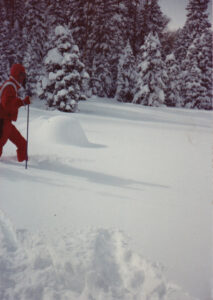
“They weren’t going to miss that snow,” he says.
Up to 7 feet fell at Northern New Mexico ski resorts in three days. For residents, the storm meant shoveling, canceled school and waiting for a way out. At Taos Ski Valley, it meant a rush of determined powder skiers and an enormous amount of work to manage the snow above them.
The storm’s scale appears in a weather-history compilation citing the National Weather Summary and Storm Data. Its entry for Saturday (Feb. 4, 1989) records up to 84 inches at Northern New Mexico ski resorts in three days. By comparison, Alta, Utah, received 49 inches over four days, while Wolf Creek, Colorado, received 66 inches over six days.
‘Ernie’s Storm’
Ernie Blake had died that January. The huge snowfall that followed became known as “Ernie’s Storm,” a name Mickey still remembers.
Along with the powder came the work of avalanche control. Mickey recalls crews using a huge amount of ammunition for the ski area’s cannon and running low on other explosives. Replenishing the cannon ammunition was particularly difficult.
“We expended a huge amount,” he says.
Blake says one reminder of that effort became a keepsake: a clock made from the base of one of the shells.
Meanwhile, the skiers finding their way to the valley were largely locals and more advanced skiers, Mickey recalls. That much snow made skiing difficult for those with less experience.
“It was all the powder nuts,” he says.
Those skiers saw an opportunity worth the trouble of getting there. For the people running the mountain, all that snow brought demands that went well beyond clearing a road or a parking lot.
Packing a way through
At my family’s Enchanted Forest Cross Country Ski Area atop Bobcat Pass, we couldn’t even reach the trails. The roads were completely closed.
Johnnie Mutz came to the rescue with a four-wheel-drive machine fitted with chains that could plow a way through. Getting there was only the beginning. It took days to pack enough snow to support our grooming snowmobile and get the ski area ready to open.
We put on wider backcountry skis and went to work packing the snow, but the grooming snowmobile was too heavy for the deep, unpacked powder. It bogged down instead of making its rounds.
The solution came from a friend with lighter, racing-style snowmobiles. He sped around the ski area on those machines, packing the snow enough to support the heavier grooming snowmobile. Only then could we get out and groom.
A tremendous snowfall still had to become a usable trail.
Shovels and snow days
Down in Red River, the work continued around the town’s lodges. Carol Woerndle remembers her (late) husband, George, shoveling at the Alpine Lodge, which his parents, Toni and Ilse Woerndle, had owned and operated for many years.
“I was a bartender at Chubbies and I remember George shoveling nonstop that day to keep the paths clear around the hotel, bar and restaurant,” Carol recalls.
A photograph of the Alpine Lodge from 1989 shows narrow paths cut through deep banks of snow, with the lodge’s entrance at the end of a corridor of white.
Food was reportedly delivered by snowmobile to stranded residents, too.
In the Moreno Valley, the accumulation interrupted school transportation. In a published collection of winter memories, school bus driver Gina Andreoli recalled trying to spare her mother some worry.
“I told my brother in Albuquerque not to tell mom about it because she would worry herself sick,” she recalled. “We couldn’t drive the buses for a few days.”
For children, a snow day could become an adventure. Sara Saint-Hogan recalls, “no school for days and snow piles galore. And my cousin Dylan losing his boots in the snow after jumping off the roof of the shed behind the Candy Crate. We had to pull him out, and his boots didn’t come with him.”
Even for non-skiing adults, being snowbound had its pleasures. In the same published collection that included Andreoli’s account, Laurelle Gallagher recalled, “Probably the longest time I was snowed in was February, 1989 when we had between 5 to 6 feet of snow. I was homebound for eight days. It was beautiful, gorgeous. I loved it.”
Nearly four decades later, Ernie’s Storm remains a collection of such memories: paths shoveled through Red River, trails packed at Enchanted Forest and a shell casing turned into a clock at Taos Ski Valley.
And then there were the skiers who left their cars in the snow and caught a ride up the canyon. The digging out could wait. The powder couldn’t.
Before the snowplows
Long before the 1989 storm, deep snow could isolate Moreno Valley residents for weeks. In a published collection of winter memories, Joe Gherardini recalled roads that were impassable for two weeks in the early 1930s.
Elliot Andreoli remembered missing three months of school in 1929 — then making up the time in summer. Ernest Swanson recalled shoveling snow to clear valley roads that winter. A caption accompanying an archival photograph describes men and boys hired to shovel roads for 50 cents an hour.
The work could involve horses, too. Another archival photograph shows a horse helping clear drifts on Jackson Hill north of Angel Fire.