
The Santos of Millicent Rogers Museum
By Ellen Miller-Goins
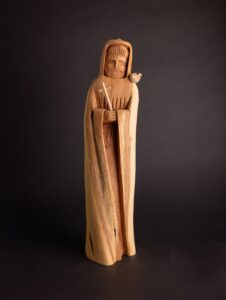
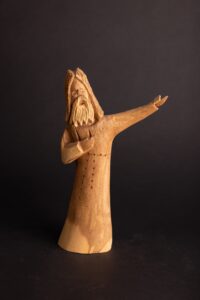
Inside Millicent Rogers Museum, carved saints gaze quietly from gallery walls and display cases. Some appear stern; others, tender. Their painted robes glow in deep reds, blues and golds, their surfaces worn with the patina that comes from time, touch and devotion. Together, these bultos and retablos form one of the most significant public collections of Northern New Mexico santos in the world.
This is not a gallery to rush through. The best way to experience it is slowly, allowing your eyes to settle on the details: a saint’s face softened by age, the faint crackle of gesso, the brushwork along a sleeve, the way wood grain emerges through paint — a quiet reminder that these images begin as something living.
For those who grew up here, santos may feel as familiar as weathered adobe and cottonwoods lining an acequia. They appear in homes, chapels and churches, serving not only as works of art but as companions in prayer and daily life. In many families, they are passed down through generations, carrying both spiritual and personal histories.
At the Millicent Rogers Museum, that living connection remains central. “Part of what is so significant and rich about the santo tradition is the reference to the masters,” says Claire Pelaez Motsinger, museum curator. “These compositions and approaches are still being used in the contemporary tradition.”
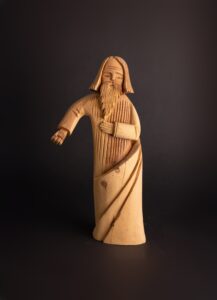
The forms themselves are simple to define, yet impossible to reduce. Bultos are carved wooden figures. Retablos are painted panels, often displayed on household altars or in churches and chapels. Both are created by santeros — artists who have shaped a distinctly Northern New Mexico tradition over centuries, tracing back to the colonial period.
Spanish missionaries introduced Catholic imagery as a way to teach religious stories. Over time, local artisans adapted these forms. Early santeros worked with what the land provided — cottonwood roots, ponderosa pine, natural pigments and piñon sap varnish. The results are not polished European icons, but something more immediate and human: sacred images shaped by local hands, knowledge, and devotion.
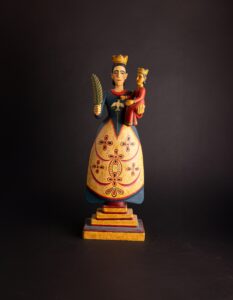
The Millicent Rogers Museum is one of only a handful of institutions with a collection of this scale. “We are one of eight museums that have more than 100 Northern New Mexico santos in their collection,” Pelaez Motsingers says. “It’s a very small group of institutions that represent this work on that scale.”
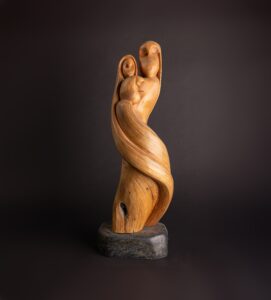
That breadth allows the museum to tell a more complete story. The exhibit is divided between historic and contemporary traditions, revealing both the roots and evolution of the form. Earlier pieces reflect Spanish colonial influence, while more recent works show how artists continue to reinterpret the tradition today.
Spend time in the gallery, and the distinctions begin to blur. Across centuries, the same gestures repeat: hands raised in blessing, eyes lifted upward, bodies carved with quiet intensity. What changes is not the purpose, but the artist’s voice.

“The museum demonstrates not just the objects, but a real sense of place,” Pelaez Motsinger says.
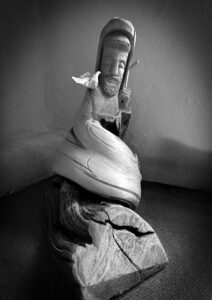
That sense of place is everywhere — in the materials, in the forms, even in the gallery itself. The rooms echo the textures and tones of Northern New Mexico, grounding the collection in the landscape that shaped it.
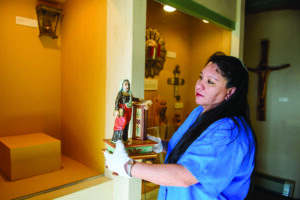
Santeros, past and present, are valued not only for their craftsmanship but for their devotion. Their work reflects a tradition that remains very much alive. Santos are not separate from everyday life. They are part of it. They have been handled, prayed to, repaired and passed down. They are artworks, certainly. But they are also reminders of a living tradition.
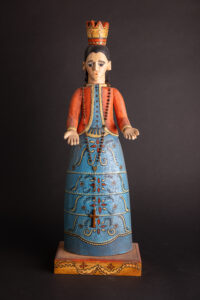
For many who pass through the gallery, the experience is not only visual. It is deeply human.
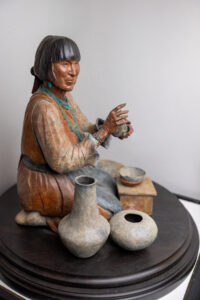
A Museum Rooted in Place
The Millicent Rogers Museum, founded in 1956 by Paul Peralta-Ramos (one of Rogers’ sons), includes 15 galleries arranged around a central courtyard in a hacienda-style layout.
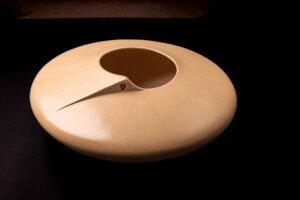
“It’s a home-like feeling combined with a formal museum setting,” says Claire Pelaez Motsinger. “We try to balance those two things.” One of the first stops for many visitors is the pottery gallery, anchored by the work of Maria Martinez of San Ildefonso Pueblo. The museum’s collection traces the arc of her career, from early polychrome and redware to the iconic black-on-black pottery she developed with her husband, Julian, and later continued with her family.
Nearby galleries expand that story of place and tradition. The museum holds more than 7,000 objects, including Native American art, jewelry, textiles and Hispanic devotional works, offering a broad view of the cultures that shape Northern New Mexico. The museum is moving toward a more focused exploration of the cultures it represents, while continuing to refresh galleries and rotate objects.
“We represent Hispanic and Native traditions in the area,” Pelaez Motsinger says. “That’s really where deeper education can happen.”
Following the death of executive director Karen Chertok, the museum is in the process of hiring new leadership, with a new executive director expected soon.
Millicent Rogers Museum
1504 Millicent Rogers Rd, El Prado
575-758-2462