
Taos herbalist Rob Hawley guides visitors and locals on wildcrafting herb walks
By Cindy Brown
Plant medicine is science, says Rob Hawley, co-founder of Taos Herb Company.
The business has a storefront at 710 Paseo del Pueblo Sur, Suite J, but Hawley also offers educational wildcrafting tours in nature several times a year.
“Almost all of our modern-day drugs come from plants,” he says. And they also remain embedded in cultural systems of belief and healing.
“Plants are scientific, but they also have a folk use,” Hawley says. “This is the part of plant medicine that is handed down mother to daughter or father to son. This is where we have a lot of really rich belief systems that frequently overlap the scientific.”
Plants can also carry spiritual meaning. Hawley says Native people often use plants both as functional medicine and as spirit medicine in ceremony.
When gathering plants, Hawley follows practices of giving thanks and restoring the earth where the plants were taken. His teachers — both Hispanic Norteño and Native — taught him those traditions. He says he is simply part of a long, continuing tradition of using local plants for food and medicine in Northern New Mexico.
“The difference between Western medicine and herbal medicine is that the Western approach is patriarchal, top-down,” he says, “whereas folk medicine empowers the individual to heal themselves and comes from Mother Earth-based healing.”
Herb walk
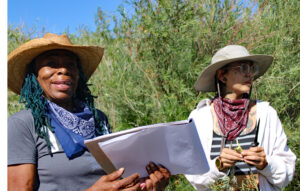
On a Saturday last July, a group of 15 people gathered under overcast skies at Taos Herb to join Hawley for an herb walk east of Taos in the flatlands and mountains.
Some participants, like Mitzi Mortensen and Jen Vaughn, are relatively new to the area and hoped to connect with the land by learning about local herbs. A mother and daughter, Angela and Michelle Martinez, came to remember what their ancestors once practiced and to continue that culture and tradition. Others, like Sage Romero, already study plants and herbs and wanted to expand their knowledge to become more self-sufficient.
Those who have joined herb walks before brought their herb journals, which Hawley says are one of the best ways to learn about plants.
“By collecting samples of herbs and saving them in a journal, you can create your own plant press that will allow you to increase your knowledge by looking up the plants in books and on the internet after you collect them,” he says.
Heading out of town on NM 518, the group stopped at a pullout for their first lesson in collecting plants. After covering basic principles of herbal medicine, Hawley cut some willows — a species of the populous family known as jara or jarita in Spanish — and showed the group how to skin the bark from the stem.
The next step, he says, is to dry the bark in shallow bags out of direct sunlight and chop it into small pieces. The bark can be simmered in hot water for about 30 minutes or more to make a tea.
“Willow contains salicin, so it is like aspirin in that it is anti-inflammatory and analgesic, but it is not as strong, so there is almost no potential for toxicity,” he says. “It is useful for headaches or menstrual cramps or any kind of pain you can think of.”
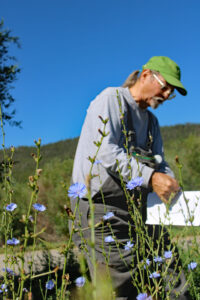
Hawley also points out blue chicory flowers and explains that the most useful part of chicory is the root, which acts as a diuretic used traditionally to treat urinary tract infections. In folk medicine, people believe roots hold their strongest energy in the fall, so gatherers often collect them closer to the end of the year.
Next, Hawley cuts a branch of what locals call sagebrush — chamiso pardo or chamiso hediondo in Spanish — which belongs to the aster family. The bitter plant prepares the body to digest food.
The group then heads toward U.S. Hill, turns onto a forest road and follows the rutted track, still wet from recent monsoons, into the woods.
At the first meadow, Hawley points out the plant mullein.
“Even though it hasn’t been here that long, perhaps 150 years, traditional Spanish midwives used the root as a postpartum sitz bath,” Hawley says.
After stopping for lunch in the shade, the group heads farther up the road. In a wooded area they find osha — osha de la sierra in Spanish — which grows only above 8,500 feet on north-facing slopes in mixed aspen and conifer forests when a particular fungus is present.
Locals prize the plant for what they believe are its many healing properties. Herbalists use it as an expectorant or diaphoretic and sometimes to help relieve menstrual cramping. Because it produces a mild numbing effect, herbalists also use osha in traditional medicine to soothe a sore throat.
“If you have a cold in the wintertime with a cough and sore throat, osha is one of the most soothing things you can use,” Hawley says. “It has a strong smell and tastes like celery amplified by 50 times.”
Along the walk, Hawley points out other healing plants such as arnica, valerian and betony. He also shows the group poisonous plants including mountain larkspur and Indian paintbrush.
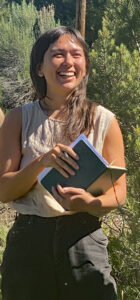
After a long day of collecting herbs, participants leave tired but excited to use their new knowledge in their own lives. Angela Martinez says the experience offered a powerful way to reconnect with the traditions of her ancestors.
As the group gathers for a photo, the moment carries a sense of cohesion and shared purpose. Psychologist Dacher Keltner describes this feeling as “collective effervescence” — the sense of connecting to something larger than yourself while participating in a like-minded group.
“This group was remarkable for how excited and stimulated they were by learning about plants,” Hawley says. “It’s a privilege to teach when people are so engaged.”
A long relationship with herbs
Hawley holds extensive knowledge of plants and their many uses. He has led herb walks for 40 years but began his career as a cancer research technician at the University of New Mexico Cancer Research Center.
“I was originally in science,” Hawley says. “My dad was a doctor, and we took an herb walk with well-known plant expert Michael Moore, and I got turned on by plants. Shortly thereafter, I opened Taos Herb with my sister, Tina Hahn, and wife Julie, so I’ve been studying plants for the last 45 years. My basic bent is a science leaning.”
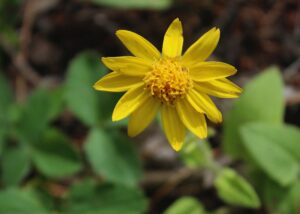
The herb walks grew from that interest. Hawley usually leads a couple of them each year with groups of up to 30 people and has explored areas from the Rio Grande Gorge to Taos Ski Valley and along the Rio Chiquito.
Hawley, along with his wife and sister, sold Taos Herb to longtime employee Chelsea Crawford last year. The herb walks continue as a way to preserve and share knowledge with the community.
Visitors can stop by the shop to find some of Hawley’s favorite reference guides, including “Medicinal Plants of the Mountain West” by Michael Moore and “Healing Herbs of the Upper Rio Grande,” by L.S.M. Curtain, revised and edited by Moore. He also recommends the hard-to-find “Flowering Plants of New Mexico,” which includes hand-drawn illustrations by Robert DeWitt Ivey.
Taos Herb Company | 710 Paseo del Pueblo Sur, Suite J, Taos (Albertson’s Cruz Alta Shopping Center) | 575-758-1991 | taosherb.com